_(crop).jpg)
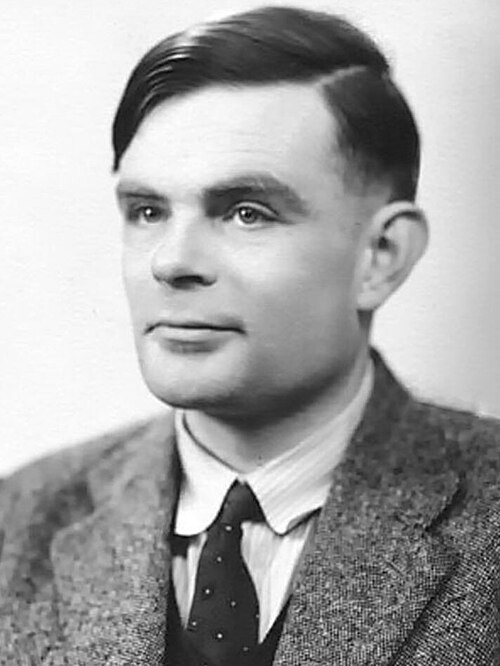
Alan Turing
A 1952 paper by Turing on self-organizing chemical patterns is cited throughout this literature as the starting point for reaction-diffusion models of embryonic pattern, in which periodic patterns arise from an unstable uniform state14. Turing also gave a device-independent definition of a computer5. Levin treats these two interests as one question6.
- Born
- 23 June 1912
- Died
- 7 June 1954
- Country
- United Kingdom
- Field
- computer scientist, mathematician, university teacher
- In the library
- 0 works, named in 12 passages elsewhere
Reaction-diffusion patterning
Funk reports that Adams and Levin traced spatially periodic, stable patterns arising from the instability of a homogeneous steady state to Turing's 1952 paper, and offered this as a mechanism for embryonic development1. Durant and colleagues describe Meinhardt and Gierer as inspired by Turing when they proposed chemical systems with local self-activation and long-range inhibition3. Funk also compares metabolic patterns, which vanish when electron flow is blocked, to the Turing-Gierer-Meinhardt model2.
Excitation and voltage patterns
Baluska and Levin note that Rosen showed in 1968 that Rashevsky's two-factor model of neuronal excitation is formally equivalent to Turing's scheme for morphogenesis. Pietak and Levin cite Turing for the point that pattern can arise by symmetry breaking in a homogeneous medium. They then ask whether voltage pre-patterns could emerge the same way in tissue, and test this in a simulation with positive feedback among cells4.
Computation and cognition
Bongard and Levin credit Turing with a formal definition of a computer that does not depend on the device. By it, any system with an internal state that reads and updates information counts, including organisms5. They add that the tape of such a machine can be hard to find in living systems. Levin argues that Turing's interest in unconventional intelligence and in embryonic self-organization were the same question, about matter that supports reprogrammable information processing6.
spatially periodic, temporally stable patterns arise from the instability of a homogenous steady state (first mentioned in a classic paper of Turing, 1952)
Funk RH, 2015 · Endogenous electric fields as guiding cue for cell migration · open at passage 27patterns arise by metabolic activators and inhibitors (similar to Turing-Gierer-Meinhardt model) which disappear when the flow of electrons is inhibited
Funk RH, 2015 · Endogenous electric fields as guiding cue for cell migration · open at passage 28Inspired by Turing's reaction−diffusion mechanisms of biological pattern formation (Turing 1952), Meinhardt and Gierer proposed dynamical chemical systems
Durant F, Lobo D, Hammelman J, Levin M, 2016 · Physiological controls of large-scale patterning in planarian regeneration: a… · open at passage 40Turing and others (Turing, 1952; Cross and Hohenberg, 1993) showed that pattern can spontaneously self-organize from symmetry breaking in initially homogeneous media.
Pietak A, Levin M, 2016 · Exploring Instructive Physiological Signaling with the Bioelectric Tissue… · open at passage 125Turing, however, provided a formal definition for computers that is device-independent: in summary, a system is a computer if it has an internal state, if it can read information from the environment
Bongard J, Levin M, 2023 · There's Plenty of Room Right Here: Biological Systems as Evolved, Overloaded… · open at passage 57It is no coincidence that Alan Turing was interested in both the question of intelligence in radically unconventional embodiments [254], and the question of self-organization of biological form during embryogenesis [255].
Levin M, 2023 · Darwin's agential materials: evolutionary implications of multiscale competency… · open at passage 68