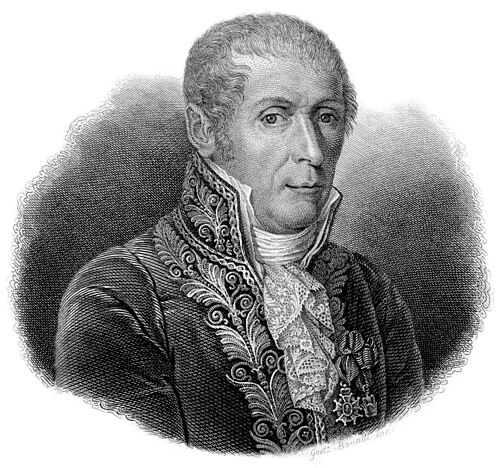

Alessandro Volta
Volta took up the frog-leg contractions that Galvani had observed and explained them by contact between different materials5. They also worked out conditions for obtaining contractions without metals1. Du Bois-Reymond later rejected the application of this contact theory to animal tissue3, while Lillie credited the frog preparation with leading Volta to current electricity6.
- Born
- 18 February 1745
- Died
- 5 March 1827
- Country
- Duchy of Milan
- Field
- physicist, inventor, academic
- In the library
- 0 works, named in 8 passages elsewhere
Explaining the frog twitch
Verworn describes Galvani's twitching frog leg on an iron railing, held by a copper hook. According to Verworn, Volta found the explanation by establishing that contact of two different materials produces the effect5. Lillie makes a related point. The frog neuromuscular preparation was the most sensitive detector of electrical change then known, and Lillie says the discovery of current electricity by Volta came from that sensitivity6.
Contractions without metals
Du Bois-Reymond records that Volta defined the conditions for contractions when no metals are used. The nerve had to touch the tendon sheet on the back of the gastrocnemius, not the muscle itself1. Volta explained this with their general theory of electro-motive action. A third, different body, the tendinous fibre, lay between nerve and muscle2. Verworn adds that Galvani answered Volta by getting twitches without metals4.
Du Bois-Reymond's objection
Du Bois-Reymond (1852) denied that the currents of muscle arise from contact of unlike tissues, as Volta supposed. In an electrical sense, he argued, nerve, muscle and tendon are homogeneous. He held that the currents are produced by the muscles themselves3. Verworn later put the same point differently. In Galvani's metal-free experiment the nerve was stimulated by current from the muscle, so Galvani became the discoverer of animal electricity4.
He showed that the nerves should be made to touch the aponeurosis of the tendo Achillis on the back of the gastrocnemius muscle, instead of the muscle itself.
Du Bois-Reymond, E. (ed. H. Bence Jones), 1852 · On Animal Electricity: Being an Abstract of the Discoveries of Emil du… · open at passage 16The efficacy of this arrangement he explained in accordance with his general theory of electro-motive action by the circumstance of a third heterogeneous body
Du Bois-Reymond, E. (ed. H. Bence Jones), 1852 · On Animal Electricity: Being an Abstract of the Discoveries of Emil du… · open at passage 16The electro-motive action on which these currents depend does not arise from the contact of heterogeneous tissues, as Volta supposed, for the different tissues, the nerves, muscles, and tendons, in an electric point of view, are quite homogeneous.
Du Bois-Reymond, E. (ed. H. Bence Jones), 1852 · On Animal Electricity: Being an Abstract of the Discoveries of Emil du… · open at passage 28In labouring to prove to Volta that the contact of metals was not necessary for the production of the twitch, he endeavoured to bring out the twitch without metals
Verworn, M., 1899 · General Physiology: An Outline of the Science of Life · open at passage 687Alessandro Volta discovered the explanation of this phenomenon by establishing the fact that in the contact of two differe
Verworn, M., 1899 · General Physiology: An Outline of the Science of Life · open at passage 686it is to this property of living tissues that we owe the discovery of current electricity by Volta.
Lillie, R. S., 1923 · Protoplasmic Action and Nervous Action · open at passage 453