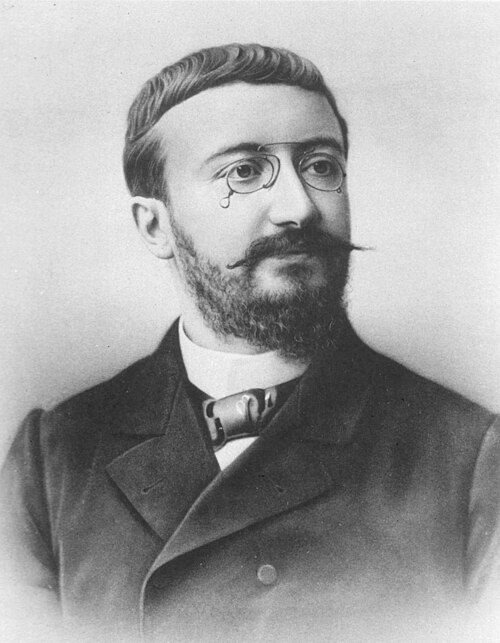
Alfred Binet
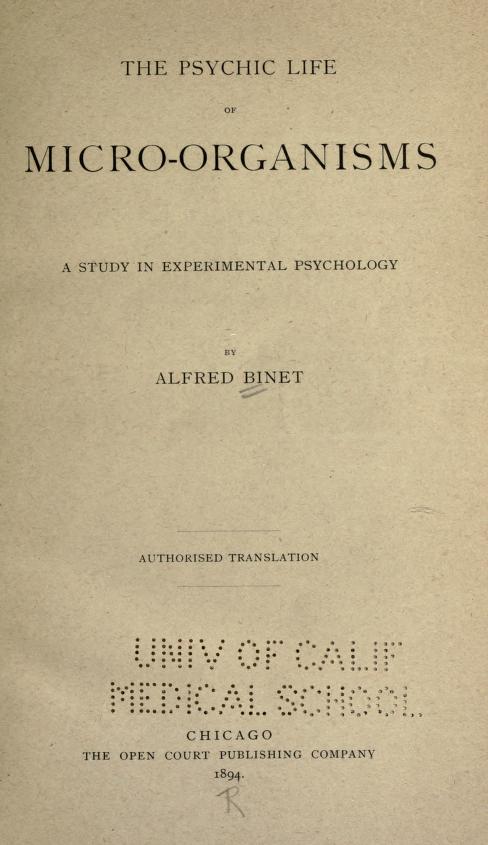
Binet wrote The Psychic Life of Micro-organisms, an essay arguing that single-celled organisms show psychological phenomena. The argument rested on general physiology: vital properties are present in undifferentiated cells, so they need not be added later in evolution12. The book also surveyed sense structures and the question of a nervous system in protozoa4.
- Born
- 8 July 1857
- Died
- 18 October 1911
- Country
- France
- Field
- psychologist, pedagogue, sociologist
- In the library
- 1 work, named in 4 passages elsewhere
- Facts from
- Wikidata · Wikipedia · Open Library
Against graded mind
Binet argued that denying psychology to lower organisms forces one to assume it is added during evolution as organisms grow more complex1. Binet held this to be inconsistent with general physiology, which finds vital phenomena already present in undifferentiated cells2. The target was Romanes, whose chart assigned intellectual powers to successive zoological stages. Binet called that chart arbitrary3. In Romanes's scheme, as Binet reports it, lowest organisms have only protoplasmic movement and excitability, and memory begins with the echinoderms3.
Nerves and sense organs
The book's contents list shows the questions Binet took up. One was whether a single cell lacks a central nervous system and might have a diffused one, with Gruber's observation of the dividing Stentor as evidence. Another was whether ocular spots in flagellates and plant zoospores act as eyes. Binet gathered work by Klebs, Pouchet, Engelmann and others, including Engelmann's tests of light sensitivity in Euglena4.
Use by later authors
Jennings named Binet's essay as a readable early treatment, presented frankly from the psychical standpoint, and credited Verworn with laying the foundations in 18895. Jennings also quoted Maupas on hunting ciliates through Binet's book6. James cited Binet on dissociation in apparently anaesthetic patients7. James also disputed Binet's theory of hallucination, saying it explained many cases but not all, and citing Tuke's counterexamples8.
If the existence of psychological phenomena in lower organisms is denied, it will be necessary to assume that these phenomena can be superadded in the course of evolution
Binet, A., 1888 · The Psychic Life of Micro-organisms: A Study in Experimental Psychology · open at passage 4Nothing could be more inconsistent with the teachings of general physiology, which shows us that all vital phenomena are previously present in nondifferentiated cells.
Binet, A., 1888 · The Psychic Life of Micro-organisms: A Study in Experimental Psychology · open at passage 4Romanes has minutely particularized on a large chart the development of the intellectual powers, in quite an arbitrary manner.
Binet, A., 1888 · The Psychic Life of Micro-organisms: A Study in Experimental Psychology · open at passage 4Absence of a central nervous system in single-celled organisms.— Hypothesis of a diffused nervous system.
Binet, A., 1888 · The Psychic Life of Micro-organisms: A Study in Experimental Psychology · open at passage 12Binet, in his "Psychic Life of Micro-organisms" (1889), gave a most readable essay on the subject, presenting it frankly from the psychical standpoint.
Jennings, H. S., 1906 · Behavior of the Lower Organisms · open at passage 4quote a portion of the words of the veteran investigator Maupas, as given in Binet's "The Psychic Life of Micro-Organisms" (pp. 48, 49)
Jennings, H. S., 1906 · Behavior of the Lower Organisms · open at passage 527The truth seems to be, as M. Binet supposes (Rev. Philos., xxm. p. 479), that these cases are not arguments for the feeling of innervation.
James, W., 1890 · The Principles of Psychology, Vols. 1-2 · open at passage 2901Dr. Hack Tuke f gives several examples in sane people of well-exteriorized hallucinations which did not respond to Binet's tests
James, W., 1890 · The Principles of Psychology, Vols. 1-2 · open at passage 1971