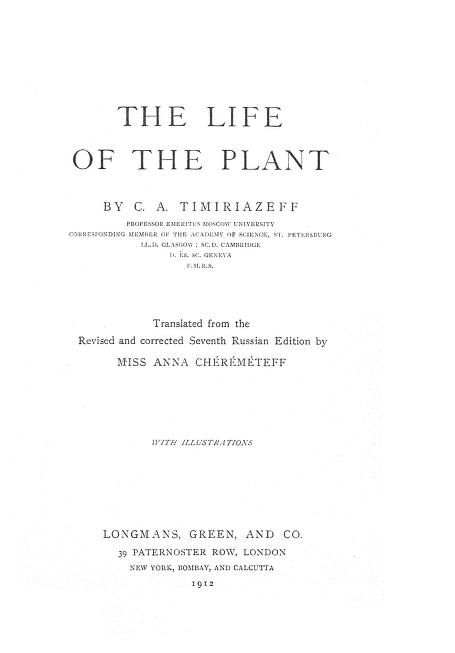
C A. Timiriazeff
Timiriazeff wrote The Life of the Plant (1912), a textbook of plant physiology that rests on the mechanistic conception and Darwinism1. It treats plant substance as matter taken from the environment2. Bayliss later cites Timiriazeff on where chlorophyll absorbs light and where starch forms56.
- In the library
- 1 work, named in 3 passages elsewhere
- Facts from
- Open Library
Measuring the root
The book gives numbers for the root of a wheat plant. Only the lower parts of the root are active, since higher up the hairs have already exhausted the nutrients in the soil particles. The total hair surface over the plant's life is almost a hundred times the field area allotted to it3. The hairs would stretch nearly thirteen miles yet fit in a thimble-sized vessel4.
Cited on light and chlorophyll
Bayliss, in Principles of General Physiology (1915), indexes Timiriazeff for starch produced at the place of maximum absorption in the spectrum5. He also credits Timiriazeff with a remark on Langley's figure of 666 millimicrons for the solar energy maximum at high sun, which lies near the main red absorption band of chlorophyll6. Bose's book on the ascent of sap lists Timiriazeff in its index at page 2347.
I am as firmly convinced as I was forty years ago that the 4 mechanistic conception 9 and Darwinism have been bequeathed by the 4 wonderful century ’ to the still infant science of plant physiology
Timiriazeff, C. A., 1912 · The Life of the Plant · open at passage 4Law of the conservation of matter. Origin of plant-substance —in the external environment. Elements and compounds entering into the composition of plants.
Timiriazeff, C. A., 1912 · The Life of the Plant · open at passage 12we find that this surface is almost a hundred times larger than the area of land allotted in the fields to each wheat plant.
Timiriazeff, C. A., 1912 · The Life of the Plant · open at passage 216they could all be packed into a vessel of the size of a thimble (about 1*5 cubic centimetres)
Timiriazeff, C. A., 1912 · The Life of the Plant · open at passage 216starch produced at place of maximum absorption (Timiriazeff) 563
Bayliss, W. M., 1915 · Principles of General Physiology · open at passage 3255The latter number is easy to remember, as Timiriazeff points out, being the " number of the beast.
Bayliss, W. M., 1915 · Principles of General Physiology · open at passage 2415Tilting Electric Recorder for exudation, 133 Timiriazeff, 234 Tonic condition
Bose, J. C., 1923 · The Physiology of the Ascent of Sap · open at passage 581