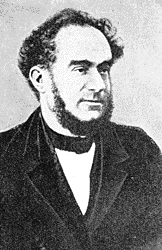

Carlo Matteucci
Matteucci worked on animal electricity before du Bois-Reymond's methods reshaped the field, and Verworn counts him among those who developed it1. Du Bois-Reymond later disputed his statements on muscle and his claim to the negative variation of the muscular current23. Lillie cites his core-conductor experiments4.
- Born
- 20 June 1811
- Died
- 24 June 1868
- Country
- Kingdom of Italy
- Field
- physicist, neuroscientist, politician
- In the library
- 0 works, named in 5 passages elsewhere
Place in the field
Verworn lists Matteucci with Pfaff, Humboldt, Ritter and Nobili as workers who advanced the science of animal electricity1. Verworn says it was du Bois-Reymond who placed the field on a clear, exact footing with sure methods. The field had before that been half-mystical and a support of the doctrine of vital force. In this account Matteucci belongs to the earlier stage of the work, before du Bois-Reymond's methods.
Dispute with du Bois-Reymond
Du Bois-Reymond's 1852 abstract, edited by Bence Jones, includes a reply to a pamphlet by Matteucci. Its contents list sections on Matteucci's personal attacks and scientific objections. It also covers his successive statements on the electric behaviour of muscle during contraction2. Another section examines his claim to have discovered the negative variation of the muscular current3. Du Bois-Reymond says Matteucci's last pamphlet omits certain facts, so that a reader might think du Bois-Reymond began the controversy4. The passages give only one side of the quarrel.
Later citation
Lillie (1923) cites Matteucci in a discussion of polarization at metal surfaces. He names the core-conductor experiments of Hermann, Matteucci and Boruttau, which used a platinum wire5. Lillie compares these with a passive iron wire in nitric acid, whose activation and transmission resemble those of nerve. The passage does not describe what Matteucci measured in those experiments.
Pfaff, Humboldt, Ritter, Nobili, Matteucci and others laboured in the further development of the science of animal electricity
Verworn, M., 1899 · General Physiology: An Outline of the Science of Life · open at passage 688Signoe Matteucci's successive statements eegaeding the Electeic Deportment of Muscles during contraction
Du Bois-Reymond, E. (ed. H. Bence Jones), 1852 · On Animal Electricity: Being an Abstract of the Discoveries of Emil du… · open at passage 0SiGNOR Matteucci's claims to the discovery of the Negative Vaeiation of the Muscular Current dpeing contraction examined
Du Bois-Reymond, E. (ed. H. Bence Jones), 1852 · On Animal Electricity: Being an Abstract of the Discoveries of Emil du… · open at passage 0I am desirous of mentioning these facts, because Signor Matteucci does not allude to them in his last pamphlet, so that any one unacquainted with the circumstances might easily be led to suppose that I have provoked this controversy.
Du Bois-Reymond, E. (ed. H. Bence Jones), 1852 · On Animal Electricity: Being an Abstract of the Discoveries of Emil du… · open at passage 6just as in the case of the platinum wire in the core-conductor experiments of Hermann, Matteucci, and Boruttau.
Lillie, R. S., 1923 · Protoplasmic Action and Nervous Action · open at passage 633