Charles Darwin
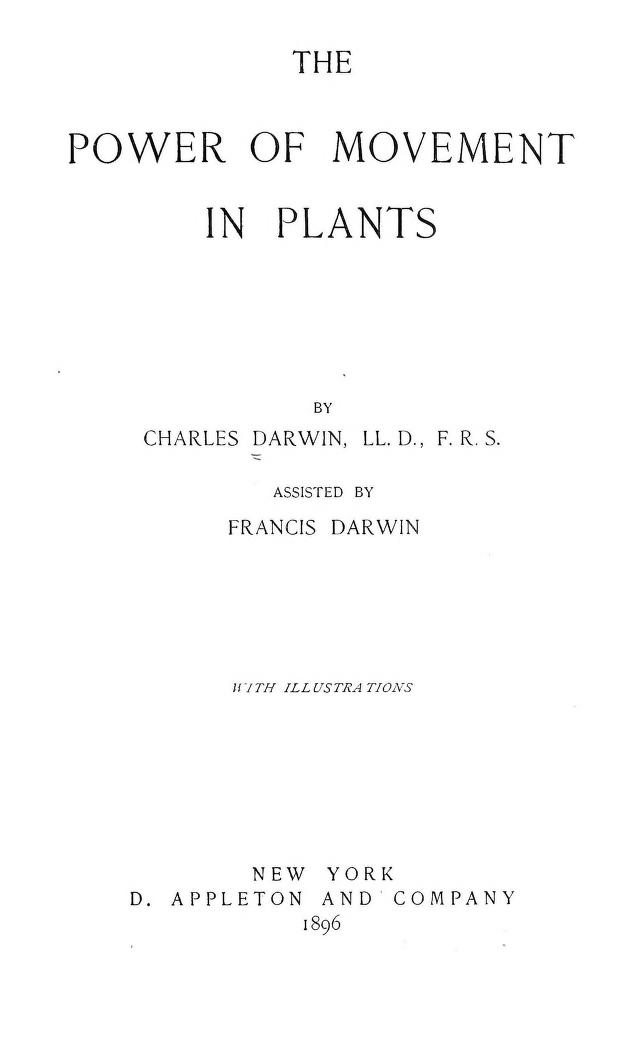
In The Power of Movement in Plants, Darwin described circumnutation, the revolving movement of a growing tip, as common to almost all plants and of the same kind as the movement of a climbing stem1. The book took Sachs's earlier idea but chose a new term2. Later authors cite it as classic work showing animal-like activity in plants6.
- Born
- 12 February 1809
- Died
- 19 April 1882
- Country
- United Kingdom of Great Britain and Ireland
- Field
- geologist, explorer, travel writer
- In the library
- 1 work, named in 12 passages elsewhere
- Facts from
- Wikidata · Wikipedia · Open Library
Circumnutation and its modifications
Darwin described a bent stem turning gradually through north, east, south and west and back again. The tip would trace a circle, or a rising spiral, because the stem keeps growing upward1. He held that other movements are modified forms of this one. Bose, writing in 1906, summarised the claim for light-driven bending: the existing movement is increased in one direction and lessened or stopped in others4. Bose said the crucial test would be an organ with no circumnutation, which is hard to find. Darwin noted the point but could not apply the test5.
Measuring cold on sleeping leaves
The book reports experiments with plants exposed to a clear night sky. In one trial a pot stood outside for 35 to 40 minutes. Darwin counted what was killed. About 250 leaves had been allowed to go to sleep, and about 20 of them (8 per cent.) were killed and about 30 injured3.
Use by later authors
Baluska and Levin, in 2016, name Darwin's 1880 book among the classic studies showing animal-like features in plants. They pair it with the work of Claude Bernard and later Bose, and note that plant action potentials are still ignored by mainstream textbooks6. Crile, in 1926, discusses a different idea of Darwin's, pangenesis, as an early demand for a physical basis of heredity. Crile argues that specific energy, not form, is the fundamental basis, and says this offers an explanation of the theory without contradicting it7.
The most widely prevalent movement is essentially of the same nature as that of the stem of a climbing plant, which bends successively to all points of the compass, so that the tip revolves.
Darwin, C., 1880 · The Power of Movement in Plants · open at passage 12This movement has been called by Sachs “revolving nutation;” but we have found it much more convenient to use the terms céreumnutation and cireumnutate.
Darwin, C., 1880 · The Power of Movement in Plants · open at passage 12By counting a portion of the leaves we estimated that about 250 had been allowed to go to sleep, and of these about 20 were killed (i.e. only 8 per cent.), and about 30 injured.
Darwin, C., 1880 · The Power of Movement in Plants · open at passage 575According to this, the already existing movement (of circumnutation) had only to be increased in some one direction, and lessened or stopped in others, in order to become heliotropic or ap-heliotropic
Bose, J. C., 1906 · Plant Response as a Means of Physiological Investigation · open at passage 1350The difficulty of obtaining such a specimen is, however, so great, that Darwin, although he noted the point, was unable to apply the test.
Bose, J. C., 1906 · Plant Response as a Means of Physiological Investigation · open at passage 1350The classic studies on plants showing animal-like features and activities were accomplished more that 150 years ago by Charles Darwin, assisted with his son Francis Darwin
Baluška F, Levin M, 2016 · On Having No Head: Cognition throughout Biological Systems · open at passage 29The demand for a physical basis for heredity was recognized by Darwin in his pangenesis theory, and by the conceptions of Weissman, Naegeli, De Vries and Spencer
Crile, G. W., 1926 · A Bipolar Theory of Living Processes · open at passage 325