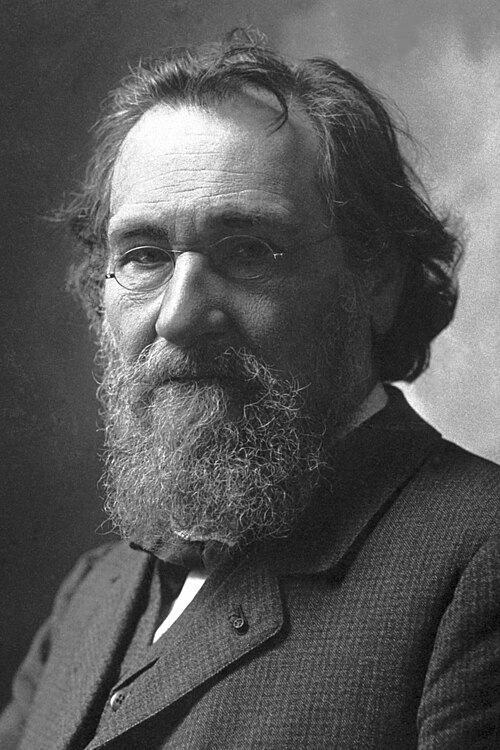
Élie Metchnikoff
Metchnikoff wrote on the problems of life, sex, death and the fear of death, drawing on biology as a whole1. In The Nature of Man he treated parts of the human body as ill fitted to it, including the large intestine and its microbes2. Loeb later cited his study of natural death in silkworm moths45.
- Born
- 3 May 1845
- Died
- 2 July 1916
- Country
- France
- Field
- biologist, immunologist, zoologist
- In the library
- 1 work, named in 2 passages elsewhere
- Facts from
- Wikidata · Wikipedia · Open Library
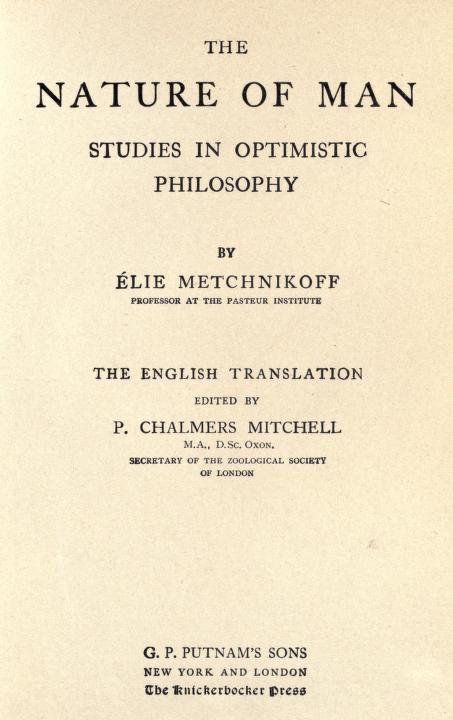
The Nature of Man
A prefatory note presents the book as the work of a specialist in the science of life, addressed to the gravest problems of humanity: life, sex, death and the fear of death1. The contents list shows the method. It takes organs such as the large intestine and asks what use they serve. It also lists the harm done by intestinal microbes and the frequency of cancer of the large intestine and of the stomach2. In the held text the argument also covers sexuality. Metchnikoff holds that its disharmonies lead to aberrations, and that this is why religions came to denounce human nature as vile3.
Natural death in moths
Loeb reports that Metchnikoff studied natural death in the silkworm butterfly. The adults lack the organs for taking up food, so their lives are short. Metchnikoff recorded that they could live twenty-three days, with an average of 15.6 days for males and 16.6 for females4. Loeb adds that seventy-five per cent of them had no parasitic fauna or flora in the intestine, and that the changes of old age in man were absent from their tissues. Metchnikoff was inclined to think an excretion retained in the body poisoned the animal5.
Use by Loeb
Loeb set Metchnikoff against Minot. Minot had argued that death is the price metazoa pay for the greater differentiation of their cells, and Loeb called this purely metaphorical. Loeb wrote that he was inclined to follow Metchnikoff. On this view natural death comes from a poison accidentally or unavoidably formed in the body, or from some structural shortcoming6.
In the volume that he has now given to the public, he has addressed himself to the gravest and the most serious problems of humanity, to life and sex and death and the fear of death.
Metchnikoff, E., 1903 · The Nature of Man: Studies in Optimistic Philosophy · open at passage 4Injurious effect of the microbes of the large intestine- -Frequency of cancer of the large intestine and of the stomach
Metchnikoff, E., 1903 · The Nature of Man: Studies in Optimistic Philosophy · open at passage 12It is simply because the disharmonies of sexuality lead to sexual aberrations that religions have found cause for denouncing human nature as vile.
Metchnikoff, E., 1903 · The Nature of Man: Studies in Optimistic Philosophy · open at passage 216Metchnikoff observed that these butterflies could live twenty-three days, but the average duration of life was 15.6 for the males and 16.6 days for the females
Loeb, J., 1916 · The Organism as a Whole, from a Physicochemical Viewpoint · open at passage 553Metchnikoff is inclined to believe that the animal is poisoned by some excretion retained in
Loeb, J., 1916 · The Organism as a Whole, from a Physicochemical Viewpoint · open at passage 553We are inclined, however, to follow Metchnikoff and suspect some poison accidentally or unavoidably formed in the body or some structural shortcoming
Loeb, J., 1916 · The Organism as a Whole, from a Physicochemical Viewpoint · open at passage 555