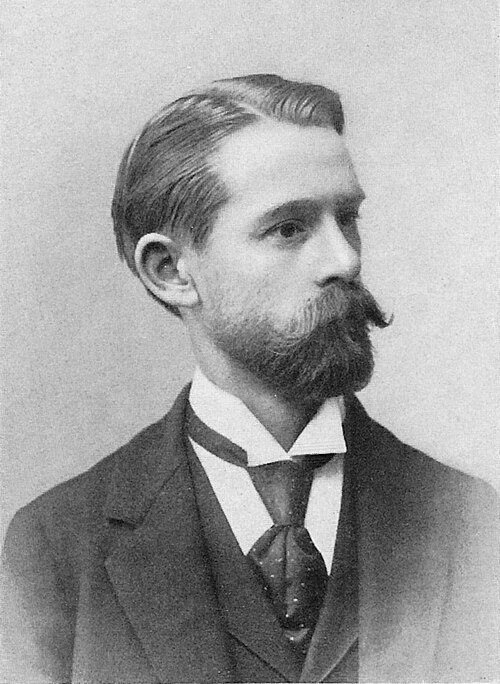
Herbert Spencer Jennings
Jennings studied the behavior of simple organisms by testing how they respond to stimuli applied to different parts of the body1. He suggested that oriented light reactions arise from changes in light intensity produced by the animal's own movements2. Loeb rejected this and named Jennings and Mast as its only supporters3.
- Born
- 8 April 1868
- Died
- 14 April 1947
- Country
- United States
- Field
- zoologist, geneticist, botanist
- In the library
- 1 work, named in 12 passages elsewhere
- Facts from
- Wikidata · Wikipedia · Open Library
Sensitivity and short memory
Jennings reported that the anterior end of an animal is usually much more sensitive than the rest of the body surface. A light touch with no effect at the posterior end gave a strong reaction at the anterior end1. Unlocalized stimuli, such as jarring the vessel, acted like stimulation of the anterior end and caused the avoiding reaction. In Stentor he described a change of behavior after experience. The animal reacted in one way, then in another. The change lasted only a short time5.
Light reactions disputed
Washburn reported Jennings's suggestion that directed light reactions result from intensity changes caused by the animal's own movements2. She noted that evidence for a direction of light was once used against it. Loeb held that Jennings had applied one law of sudden intensity change to all unicellular heliotropism. He cited Torrey and Bancroft, who found on Euglena that the statements rested on incomplete observations4. Loeb also said that few workers in the field upheld the theory3.
Use by later authors
Driesch accepted the term trial and error for one experiment of Yerkes. He doubted it where no experience could be shown. He also judged Jennings's "resolution of the physiological states" close to his own "historical basis of reaction"6. Lyon, in 2015, placed Jennings among early authors who held that the behavior of lower animals, including bacteria, could tell us about the behavior of higher animals7.
A light touch, having no effect at the posterior end, produces a strong reaction when applied to the anterior end.
Jennings, H. S., 1906 · Behavior of the Lower Organisms · open at passage 336Now Jennings (373), has suggested that the oriented reactions of certain organisms, at least, are really due to changes in the intensity of the light, brought about by the animal’s own movements.
Washburn, M. F., 1908 · The Animal Mind: A Textbook of Comparative Psychology · open at passage 327It is only upheld by Jennings and Mast; and is accepted among those to whom the idea of a physicochemical explanation of life phenomena does not appeal.
Loeb, J., 1916 · The Organism as a Whole, from a Physicochemical Viewpoint · open at passage 425Jennings has maintained that the heliotropic reactions of unicellular organisms are all of this kind, but investigations by Torrey and by Bancroft2 on Euglena have shown that Jennings's statements were based on incomplete observations.
Loeb, J., 1916 · The Organism as a Whole, from a Physicochemical Viewpoint · open at passage 418The modification in the behavior induced by experience seems to last but a very short time. Immediately after reacting in one way, which proves ineffective, it reacts in another.
Jennings, H. S., 1906 · Behavior of the Lower Organisms · open at passage 504What Jennings calls the "resolution of the physiological states one into another" expresses about the same as does my "historical basis of reaction.
Driesch, H., 1908 · The Science and Philosophy of the Organism · open at passage 243At the beginning of the 20th century, Jennings (1905/1962) claimed the behavior of the ‘lower animals,’ notably paramecia but including bacteria, could tell us much about the behavior of the ‘higher animals,’ including humans.
Lyon P, 2015 · The cognitive cell: bacterial behavior reconsidered · open at passage 2