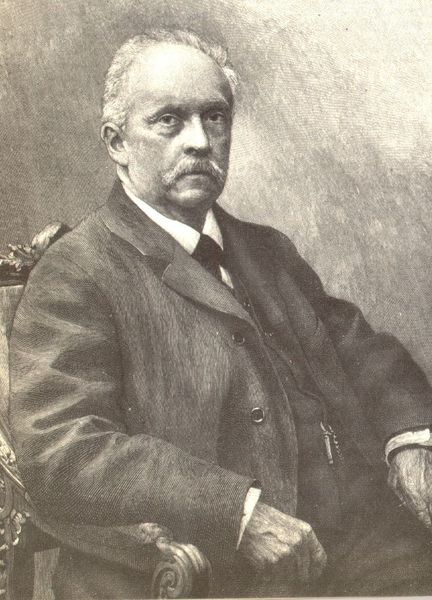

Hermann von Helmholtz
Helmholtz is credited in the held texts with first showing that a nerve impulse takes measurable time to travel, which put a nervous process into numbers1. He also described how a fatigued muscle's contraction curve changes4, argued that colour and space perception are intellectual acts5, and worked on fluid motion8.
- Born
- 31 August 1821
- Died
- 8 September 1894
- Country
- Kingdom of Prussia
- Field
- physicist, ophthalmologist, musicologist
- In the library
- 0 works, named in 12 passages elsewhere
Speed of the nerve impulse
Bayliss says Helmholtz (1850) first definitely showed that an impulse takes time to cross a nerve. He adds that this affected views of mental phenomena, because a nervous process could now be expressed as a number1. The frog value was 29 metres per second. Bayliss sets it beside Piper's 1912 figure of 123 metres per second in man, taken with the string galvanometer2. Bose cites Helmholtz's human value of about thirty-three metres per second. He notes that later determinations gave twice as much, and that the record is hard to read exactly3.
Muscle fatigue and perception
Verworn reports that Helmholtz discovered a change in the muscle curve with fatigue. The curve falls in height and grows longer, mainly because the descending limb lengthens4. In psychology, James treats Helmholtz as holding that colour perception, like space perception, is intellectual. Simultaneous colour contrast is explained as an unconscious inference. James accepts the weight of this authority but disputes it, and he follows Hering's view of contrast5. Rádl says physiologists such as Helmholtz tried to fit their views to the doctrine of specialised nerve cells7.
Life, flight and fluids
Verworn records that Helmholtz and Sir William Thomson, some years after Richter, discussed whether life might have reached the earth from other heavenly bodies. Both called the idea not unscientific6. D'Arcy Thompson cites Helmholtz's 1873 paper on geometrically similar motions of fluid bodies and its application to steering balloons. He notes that Müllenhof criticised the result in the 1880s, which Thompson calls somewhat rash8.
The fact that the nerve impulse takes time to traverse a nerve was first definitely shown by Helmholtz (1850) and had an important effect on views taken with regard to mental phenomena
Bayliss, W. M., 1915 · Principles of General Physiology · open at passage 1722The value obtained by Helmholtz for the frog was 29 m. per second. In man, the latest value, obtained by Piper (1912, p. 52), is 123 m. per second.
Bayliss, W. M., 1915 · Principles of General Physiology · open at passage 1722For example, Helmholtz found this velocity in man to be about thirty-three metres per second. Some recent determinations, again, give a value twice as great.
Bose, J. C., 1906 · Plant Response as a Means of Physiological Investigation · open at passage 610Then it is found that, as Helmholtz discovered, with increasing fatigue not only does the curve decrease in height, but it becomes more extended
Verworn, M., 1899 · General Physiology: An Outline of the Science of Life · open at passage 1169With Helmholtz, color-perception is equally with spaceperception an intellectual affair. The so-called simultaneous color-contrast
James, W., 1890 · The Principles of Psychology, Vols. 1-2 · open at passage 2248Independently of Richter, some years later Helmholtz and Sir William Thompson discussed the question whether life may not, perhaps, have been transferred from other heavenly bodies to the earth
Verworn, M., 1899 · General Physiology: An Outline of the Science of Life · open at passage 782Physiologists like Helmholtz endeavoured to make their views harmonize with it.
Rádl, E., 1930 · The History of Biological Theories · open at passage 583This is the result arrived at by Helmholtz, Ueber ein Theorem geometrisch ahnliche Bewegungen fliissiger K6rper betreffend, nebst Anwendung auf das Problem Luftballons zu lenken
Thompson, D. A. W., 1992 · On Growth and Form · open at passage 88