Ivan Pavlov
Pavlov worked on nerve control of muscle and later on the physiology of the cerebral hemispheres. In 1885 Pavlov showed that a mollusc's shell muscle has both exciting and inhibiting nerves1. The 1927 book reports conditioned reflexes in dogs, including fine sound discrimination5. Later authors cite Pavlov's training of organs6.
- Born
- 14 September 1849
- Died
- 27 February 1936
- Country
- Russian Empire
- Field
- chemist, physiologist, neurologist
- In the library
- 1 work, named in 6 passages elsewhere
- Facts from
- Wikidata · Wikipedia · Open Library
Nerves of the mollusc muscle
Bayliss (1915) credits Pavlov with an early study of how bivalve molluscs open and close their shells. The strong adductor muscle was found to receive two sets of nerves, one exciting and one inhibiting1. Pavlov noted that the muscle holds no nerve cells of its own, so both influences must act directly on the muscle cells2. Bayliss adds that Pavlov inferred separate parts inside the fibres for contraction and for relaxation, and links this to later theories of receptive substances3.
Cortex and conditioned reflexes
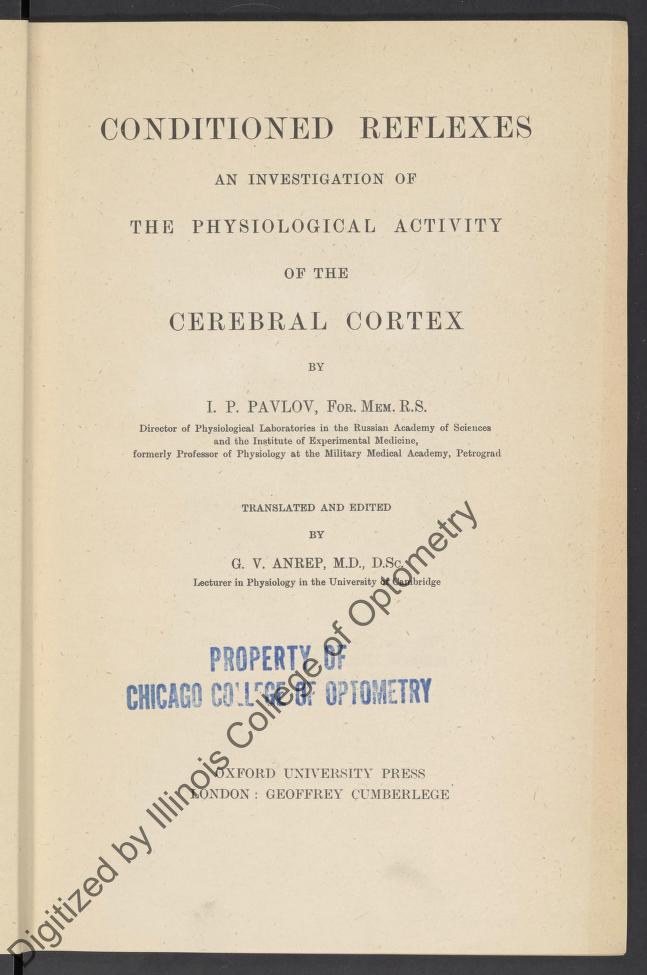
The 1927 book opens by noting that the hemispheres once seemed out of reach of the physiologist4. Stimulation and removal of cortical areas had by then been applied to them by others. Pavlov's own chapters report conditioned reflexes in dogs. The animals were tested on differences of timbre and of sound direction5. In the metronome tests the dog separated rates as close as 100 and 96 beats per minute. Pavlov judged this finer than human discrimination.
Later readers
Bayliss (1915) sent readers to Pavlov's 1911 to 1913 papers on excluding extraneous stimuli, and to Orbeli's work as an example from Pavlov's laboratory. Fields and Levin (2022) say Pavlov understood that organs, and not only whole animals, could be trained. They argue that such experiments can now be repeated with better tools6. Coenen and Zayachkivska (2013) record a different link. Pavlov's intervention in 1916 helped secure the release of the Lemberg physiologist Adolf Beck7.
The arrangement by which the bivalve molluscs open and close their shells was investigated by Pavlov (1885), who found that the powerful adductor muscle is supplied with two sets of nerves, exciting and inhibiting.
Bayliss, W. M., 1915 · Principles of General Physiology · open at passage 1778there are no nerve cells in the muscle itself, so that the two kinds of influence must be exercised on the muscle cells directly.
Bayliss, W. M., 1915 · Principles of General Physiology · open at passage 1778Pavlov states that there must be special parts in the interior of the muscle fibres on which the contraction depends, and others on which the relaxation depends.
Bayliss, W. M., 1915 · Principles of General Physiology · open at passage 1778in fact, there was no physiology of the hemispheres ; they seemed to be out of reach of the physiologist.
Pavlov, I. P., 1927 · Conditioned Reflexes: An Investigation of the Physiological Activity of the… · open at passage 12The differentiation of timbre and the differentiation of direction of sounds were also submitted to investigation
Pavlov, I. P., 1927 · Conditioned Reflexes: An Investigation of the Physiological Activity of the… · open at passage 332Interestingly, this was well-appreciated by Pavlov, whose early work included training animals’ organs in addition to the animals themselves.
Fields C, Levin M, 2022 · Competency in Navigating Arbitrary Spaces as an Invariant for Analyzing… · open at passage 67in 1916 he was released by the intervention of the famous Russian scientist and Nobel Prize winner Ivan Pavlov (1849-1935), working in St. Petersburg, and a friend of Napoleon Cybulski.
Coenen A, Zayachkivska O, 2013 · Adolf Beck: A pioneer in electroencephalography in between Richard Caton and… · open at passage 13