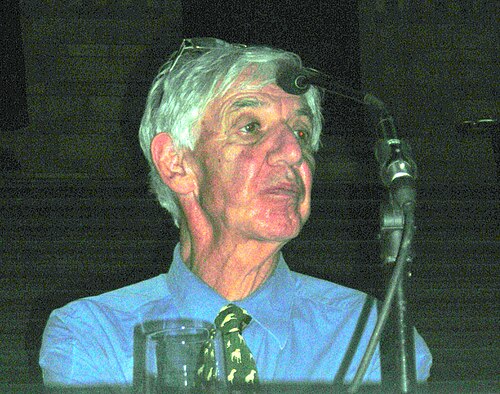

Lewis Wolpert
Lewis Wolpert is cited in these works for the theory of positional information. In it, a morphogen gradient along an axis lets cells decode their relative positions and make decisions in embryogenesis or regeneration2. The French-flag metaphor illustrated such a gradient pattern3. Later authors place the theory in a line of gradient models that includes Child and Spemann1.
- Born
- 19 October 1929
- Died
- 28 January 2021
- Country
- South Africa
- Field
- biologist, university teacher, engineer
- In the library
- 0 works, named in 4 passages elsewhere
Positional information
Manicka and Levin describe Wolpert as a pioneer of pattern formation models. They credit the concept of positional information: a morphogen gradient develops along an axis, and cells use it to decode their relative positions and make morphogenetic decisions2. The same passage says Wolpert used the 'French-flag' metaphor to characterize a gradient-like pattern. They add that Wolpert later proposed models for how such patterns could be developed, sustained and even regenerated3.
Place among gradient models
Durant and colleagues treat Wolpert's positional information theory (1969) as one of a series of historical models. Their list also names Child's gradient model and Spemann's organizer concept1. They introduce the series with Morgan's suggestion of a substance gradient that signals whether a head or a tail regenerates in planarians. They then note that similar gradient models have been proposed for planarian regeneration, using morphogen concentration gradients1.
The balancing model
Manicka and Levin discuss a 'balancing model' attributed to Wolpert. In it, cells are point-entities that make linear measurements, such as computing simple averages4. They say this helps in hypothesizing high-level principles but does not elucidate the underlying biological complexity. They contrast it with reaction-diffusion and neural network models. Those capture more biological complexity, but their nonlinear causal relationships are hard to analyse with conventional techniques4.
This idea was further developed in a series of historical models, including Child's gradient model (Child 1941), Spemann's organizer concept (Spemann & Mangold 2001), and Wolpert's positional information theory (Wolpert 1969).
Durant F, Lobo D, Hammelman J, Levin M, 2016 · Physiological controls of large-scale patterning in planarian regeneration: a… · open at passage 38Lewis Wolpert, a pioneer in this field, introduced the concept of “positional information”, where a morphogen gradient develops along an axis that the cells could use to decode their relative positions
Manicka S, Levin M, 2022 · Minimal Developmental Computation: A Causal Network Approach to Understand… · open at passage 3He used the famed metaphor of the ‘French-flag’ to characterize a gradient-like pattern and later proposed models for how such patterns could be developed, sustained and even regenerated
Manicka S, Levin M, 2022 · Minimal Developmental Computation: A Causal Network Approach to Understand… · open at passage 3For instance, the “balancing model” proposed by Wolpert represents cells as point-entities that make linear measurements such as computing simple averages.
Manicka S, Levin M, 2022 · Minimal Developmental Computation: A Causal Network Approach to Understand… · open at passage 5