Margaret Floy Washburn
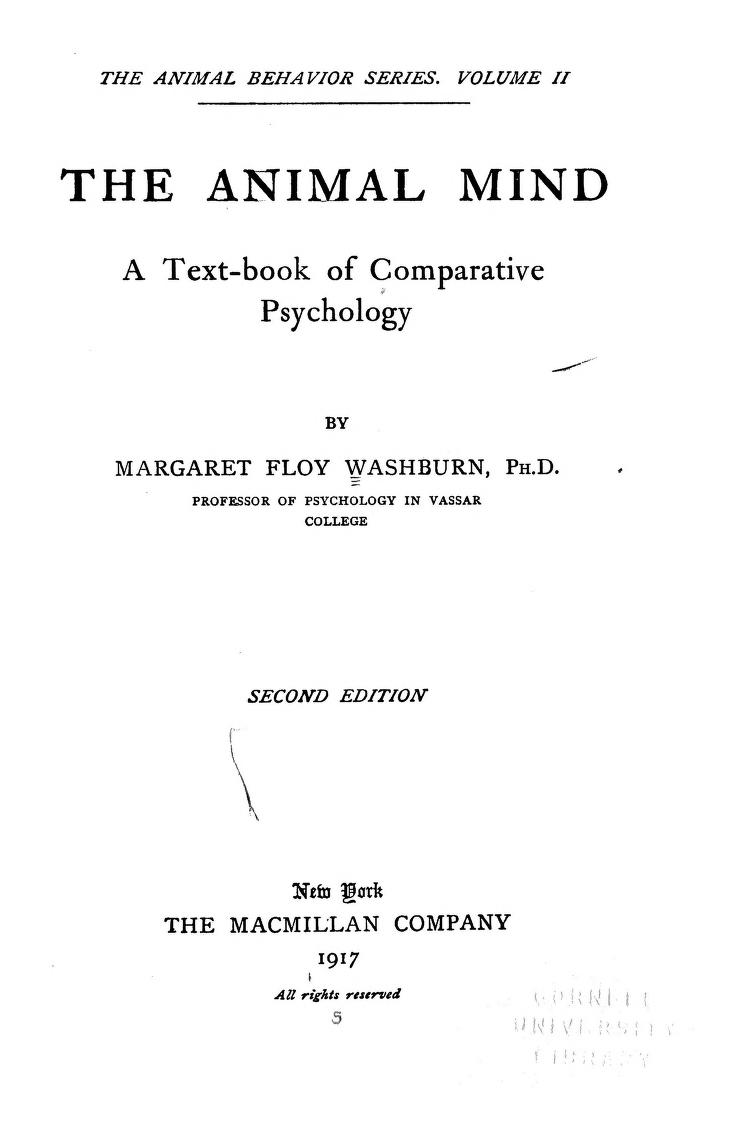
Washburn wrote The Animal Mind (1908), a textbook of comparative psychology that gathered the experimental literature on animal behaviour and sense function, from single cells upward. Later authors treated it as a reference for studying behaviour without assuming consciousness, and as an early text that began with the amoeba156.
- Born
- 25 July 1871
- Died
- 29 October 1939
- Country
- United States
- Field
- psychologist
- In the library
- 1 work, named in 2 passages elsewhere
- Facts from
- Wikidata · Wikipedia · Open Library
Scope of the textbook
Weighing the evidence
Washburn reported experiments and judged them. On spiders, Dahl found that body hairs responded to violin tones. Washburn called this test, which Hensen had applied to Mysis, of very doubtful significance, and noted that hairs on the human hand would respond too3. For Paramecium, the text lists conditions that change the response to gravity, including food supply, temperature, mechanical shock, salts and alkalies4. It also relays a suggestion that downward movement protects the animals from surface agitation, ice and loss of food4.
Later citation
Bayliss pointed readers to the book as an example of investigating the higher nervous functions without necessarily introducing consciousness5. In 2015 Lyon described it as the first US textbook on comparative psychology, one that begins with amoeba. Lyon placed it beside Jennings' claim that the behaviour of lower animals, bacteria included, can inform us about higher animals6.
The book throughout deals with comparative rather than with genetic psychology.
Washburn, M. F., 1908 · The Animal Mind: A Textbook of Comparative Psychology · open at passage 4In one or two cases, where the literature upon a single point is very large, as for example, in the case of the function of the semicircular canals, only a few of the more important references have been given.
Washburn, M. F., 1908 · The Animal Mind: A Textbook of Comparative Psychology · open at passage 4Dahl, a number of years ago, found them responding to the tones of a violin (166, 167), but this test, which Hensen applied to Mysis, is of very doubtful significance
Washburn, M. F., 1908 · The Animal Mind: A Textbook of Comparative Psychology · open at passage 201Negative geotropism, in a sense its normal condition, is favored by plentiful food supply and by an increase in temperature within certain limits
Washburn, M. F., 1908 · The Animal Mind: A Textbook of Comparative Psychology · open at passage 302The methods of comparative psychology may also be referred to as illustrating the possibility of investigation of the higher functions of the nervous system without the necessary introduction of consciousness.
Bayliss, W. M., 1915 · Principles of General Physiology · open at passage 2069The Animal Mind (Washburn, 1936), the first US textbook on comparative psychology (first edition 1908), begins with amoeba.
Lyon P, 2015 · The cognitive cell: bacterial behavior reconsidered · open at passage 2