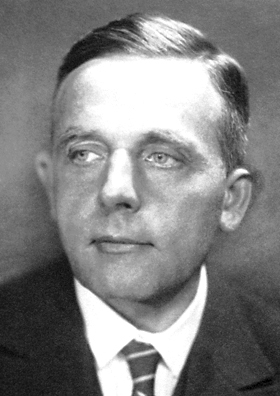

Otto Heinrich Warburg
Warburg studied how cells use oxygen. Authors of the 1910s and 1920s cited experiments showing that oxidation depends on cell structure and surface23, that iron may catalyse it5, and that salts may not enter fertilized eggs1. Later authors named the Warburg effect for cancer cells that ferment despite oxygen78.
- Born
- 8 October 1883
- Died
- 1 August 1970
- Country
- German Empire
- Field
- biochemist, chemist, university teacher
- In the library
- 1 work, named in 12 passages elsewhere
- Facts from
- Wikidata · Wikipedia · Open Library
Oxidation depends on structure
Bayliss reported that Warburg and Meyerhof found yeast activity greatly diminished by rubbing with sand, which pointed to structure as essential2. Bayliss also listed Warburg's 1910 finding that alkalies, which do not enter the cell, strongly change oxygen consumption, so surface actions mattered3. Thompson drew on Warburg for a wider point. The cell's structure acts as a mechanism that turns the energy of oxidation into work, instead of letting it fall to diffuse heat6. Loeb cited Warburg's experiments on the permeability of fertilized sea urchin eggs to salts1.
Iron, surfaces and narcotics
Hill summarised work by Warburg and colleagues as showing that many biological oxidations probably occur at surfaces, catalysed by embedded iron atoms. On that view, narcotics could displace the oxidisable substances from those surfaces and hinder oxidation5. Lillie reported Usui's work under Warburg's direction. Narcotics lowered oxygen consumption in liver and nervous tissue, but only at much higher concentrations than normal reversible narcosis needs, and the effect was imperfectly reversible4. Lillie took this to show that anaesthesia is not necessarily tied to lower intracellular oxidation.
The Warburg effect
Recent authors use the name Warburg effect for a switch from respiration to respiration plus fermentation despite the presence of oxygen. Schofield and colleagues note it in cancer cells, yeast and bacteria, and call it puzzling because respiration yields more energy per carbon7. They propose a bioelectrical reading through redox state and membrane potential, which they say remains to be tested. Carreras-Sureda and colleagues link hypoxia adaptation in solid tumours to the effect, described as reliance on anaerobic glycolysis over oxidative phosphorylation8.
But recent experiments by Warburg, which were confirmed and amplified by Harvey, make it doubtful whether the salts which are not soluble in fats can enter the fertilized egg at all.
Loeb, J., 1912 · The Mechanistic Conception of Life · open at passage 334Warburg and Meyerhof have shown that the activity of yeast cells in this respect is greatly diminished by rubbing with sand.
Bayliss, W. M., 1915 · Principles of General Physiology · open at passage 2543the great effect on oxygen consumption of alkalies which do not enter the cell itself (Warburg, 1910), and other similar actions on the surface, may be mentioned.
Bayliss, W. M., 1915 · Principles of General Physiology · open at passage 2541Usui, working under Warburg's direction,^ found also a decrease in the oxygen consumption of vertebrate tissues (liver, central nervous system) under the influence of narcotic compounds
Lillie, R. S., 1923 · Protoplasmic Action and Nervous Action · open at passage 348Recent work by Warburg and his colleagues has shown that many forms of biological oxidation probably occur as surface phenomena, catalysed by iron atoms embedded in the surface
Hill, A. V., 1926 · Muscular Activity · open at passage 189This, as Warburg has well explained, is the general effect or function of the physiological machine, and in particular of that part of it which we call
Thompson, D. A. W., 1992 · On Growth and Form · open at passage 379This effect involves the metabolic switching of cells from respiration to respiration and fermentation (i.e. respiro-fermentation), despite the presence of oxygen
Schofield Z, Meloni GN, Tran P, Zerfass C, Sena G, Hayashi…, 2020 · Bioelectrical understanding and engineering of cell biology · open at passage 8Cell adaptation to hypoxia, together with limited oxygen availability, may facilitate the Warburg effect, whereby cancer cells rely on anaerobic glycolysis instead of oxidative phosphorylation.
Carreras-Sureda A, Pihán P, Hetz C, 2017 · The Unfolded Protein Response: At the Intersection between Endoplasmic… · open at passage 12