.jpg)
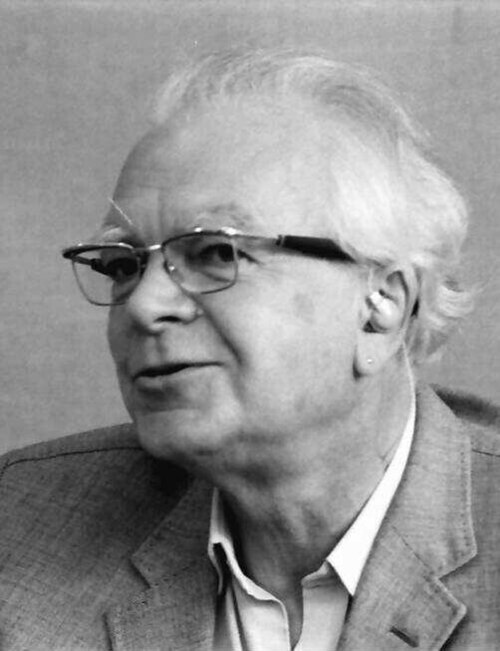
Peter D. Mitchell
Peter Mitchell is credited with the chemiosmotic theory, first released in 1961. In later accounts it links ATP synthesis to charge separation across a membrane and to the use of the resulting electrochemical gradient. Sousa and colleagues say it was generally accepted only in the 1970s. Morelli and colleagues describe disputes over its details that continued afterwards.1235
- Born
- 29 September 1920
- Died
- 10 April 1992
- Country
- United Kingdom
- Field
- biochemist, chemist, university teacher
- In the library
- 0 works, named in 12 passages elsewhere
The theory as described
Morelli and colleagues give the basic formulation of Mitchell's theory in a figure. They note that ATP synthase is drawn there, although it was not in the original release of 1961.3 At that time, they say, ATP synthesis was attributed to the membrane as a whole. It was treated as a generic removal of H+ and OH− from ADP and orthophosphate to form ATP.4 Sousa and colleagues describe the modern result: ATP comes ultimately from chemiosmotic coupling, meaning charge separation across the cell boundary.1
Acceptance over time
Sousa and colleagues contrast the theory with an older doctrine, traced to Haldane, that the earliest energy metabolism was a fermentation such as glycolysis. That doctrine arose before anyone knew that biological energy could be harnessed without substrate-level phosphorylation. They say it was not until the 1970s that it became generally apparent that Mitchell was right.2 They use the theory to argue that chemiosmosis may be a very ancient means of energy transduction.1
Disputes over coupling
Morelli and colleagues report that the dispute continued after the 1970s. In 1979 H. Tedeschi argued that mitochondrial metabolic activity could not contribute to membrane potential, while H. Rottenberg defended Mitchell's theory.5 They describe the original theory as 'delocalized coupling'. Williams supported a 'localized coupling' instead.6 The authors cite later work by Lee, and by Saeed and Lee, on protons held at the membrane surface and on a possible 'proton capacitor'. They use it to propose an update of the theory.
In modern life, all biological energy in the form of ATP comes ultimately from chemiosmotic coupling [151], the process of charge separation from the inside of the cell to the outside
Sousa FL, Thiergart T, Landan G, Nelson-Sathi S, Pereira…, 2013 · Early bioenergetic evolution · open at passage 47It was not until the 1970s that it became generally apparent that Mitchell [152] was right
Sousa FL, Thiergart T, Landan G, Nelson-Sathi S, Pereira…, 2013 · Early bioenergetic evolution · open at passage 47The basic formulation of Mitchell's theory is schematically depicted in figure 1, where ATP synthase was also indicated, differently from the original release of 1961, where necessarily it was not depicted.
Morelli AM, Ravera S, Calzia D, Panfoli I, 2019 · An update of the chemiosmotic theory as suggested by possible proton currents… · open at passage 4At the time ATP synthesis was attributed to the membrane as a whole, in the form of a generic subtraction of H+ and OH− to ADP and orthophosphate to form ATP.
Morelli AM, Ravera S, Calzia D, Panfoli I, 2019 · An update of the chemiosmotic theory as suggested by possible proton currents… · open at passage 4between H. Tedeschi, who disproved the idea that the metabolic activity of mitochondria could contribute to membrane potential, and H. Rottenberg, which instead defended Mitchell's theory [38].
Morelli AM, Ravera S, Calzia D, Panfoli I, 2019 · An update of the chemiosmotic theory as suggested by possible proton currents… · open at passage 14The original theory provides a protonated ‘delocalized coupling’ (as depicted in figure 1), as opposed to a ‘localized coupling’ supported by Williams [39].
Morelli AM, Ravera S, Calzia D, Panfoli I, 2019 · An update of the chemiosmotic theory as suggested by possible proton currents… · open at passage 14