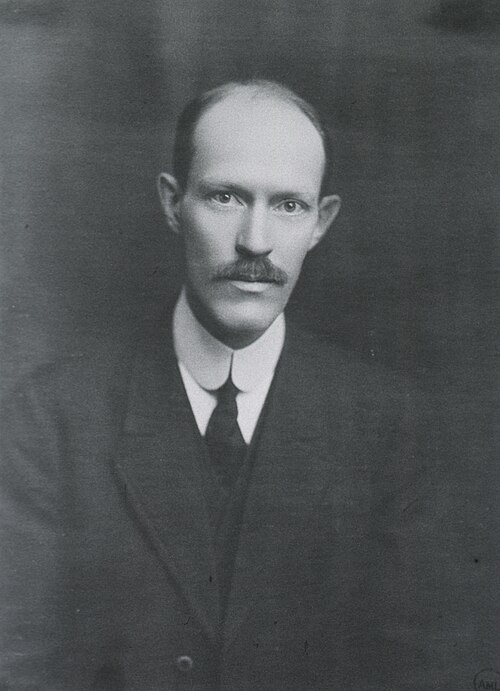

Ross Granville Harrison
Ross Harrison worked on amphibian embryos, using grafting and cell culture. He grew cells taken from frog embryos in lymph outside the body and watched nerve fibres extend from them12. He also grafted tadpole tails and embryonic limb tissue, work that later authors used in arguments about regeneration and organ boundaries46.
- Born
- 13 January 1870
- Died
- 30 September 1959
- Country
- United States
- Field
- zoologist, anatomist, biologist
- In the library
- 0 works, named in 12 passages elsewhere
Nerve fibres in culture
Bayliss dated a step forward to 1907, when Harrison found that cells separated from frog embryos and held in lymph continued to grow. The most useful results concerned nerve fibres growing from cells1. Loeb credited Harrison with modifying the earlier test-tube method of Leo Loeb so that the transplanted cell could be watched under the microscope. On that basis Harrison established that the axis cylinder grows out from the ganglionic cell2.
Grafts and regeneration
Morgan described Harrison's union of two tadpoles by their posterior ends and reproduced a figure after Harrison showing a tail followed over about ninety-five days after the pair was cut apart5. Morgan also reported that a tail grafted in reverse on another tadpole could regenerate further and form a tail-like structure. Harrison discovered this, and Morgan said he had seen it too4.
Limb field and Child's reply
Child quoted Harrison's 1918 view of the amphibian limb rudiment. It is not a sharply bounded patch like a stone in a mosaic. It is a centre of differentiation whose intensity falls with distance from the centre6. Child read this as a physiological gradient, though he noted Harrison did not treat gradients as the basic factor. Child rejected Harrison's 1921 stereochemical account of limb symmetry, saying the molecular structure was assumed without evidence7.
who found that cells separated from frog embryos and immoral in lymph continued to grow. Particularly valuable results were obtained as regards the growth of nerve fibres from cells.
Bayliss, W. M., 1915 · Principles of General Physiology · open at passage 102This was made possible by a modification of the method by Harrison, who established the fact that the axis cylinder grows out from the ganglionic cell.
Loeb, J., 1916 · The Organism as a Whole, from a Physicochemical Viewpoint · open at passage 58Ross Harrison has shown that the axons are projected in nerve cultures 19 and it is well known that the axis cylinder degenerates when it is divided beyond the nerve cell.
Crile, G. W., 1926 · A Bipolar Theory of Living Processes · open at passage 280If, however, the tail is grafted in a reverse direction on the body of another tadpole, the regeneration may go further and produce a tail-like structure, as Harrison discovered and as I have also seen.
Morgan, T. H., 1901 · Regeneration · open at passage 471A. After Harrison. Union of two tadpoles by posterior ends. Two days after operation.
Morgan, T. H., 1901 · Regeneration · open at passage 475The limb rudiment may be thus regarded, not as a definite circumscribed area like a stone in a mosaic, but as a center of differentiation in which the intensity of the process diminishes as the distance from the center increases
Child, C. M., 1924 · Physiological Foundations of Behavior · open at passage 314Harrison’s recent stereochemical interpretation of the symmetry relations of amphibian appendages in his transplantation experiments (Harrison, ’21) may be cited as a case in point.
Child, C. M., 1924 · Physiological Foundations of Behavior · open at passage 91