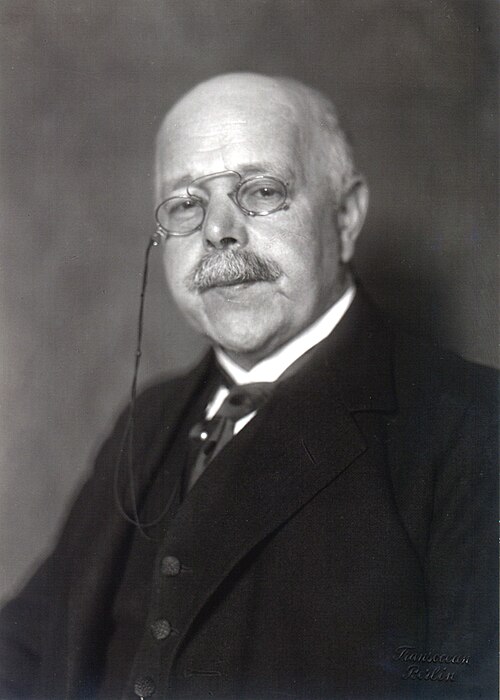

- Born
- 25 June 1864
- Died
- 18 November 1941
- Country
- Kingdom of Prussia
- Field
- chemist, physicist, university teacher
- In the library
- 0 works, named in 12 passages elsewhere
Theory of excitation
Crile summarised Nernst as holding that the electrolytes of the axis cylinder lie within membranes impermeable to certain ions. A current passes through a nerve carried by dissociated electrolytes, so ions pile up at one place. Excitation follows when the concentration reaches a certain point1. Lillie noted that Nernst reached this result by considering a single membrane placed in the path of a current. He argued that such a membrane is present in living tissue, so polarization must result when current flows2.
Support and limits
Lillie credited the theory with explaining polar stimulation and with naming a change of polarization as the condition that starts excitation3. He also listed what it leaves out. It has no critical threshold current independent of duration, and it does not treat currents of changing intensity. Hill and Keith Lucas added that the two surfaces of a small cell or fibre may interfere with each other. Bayliss quoted Lucas calling it not a complete theory but an indispensable guide. Bayliss expected the final solution to follow Nernst's lines5.
Equation and lamp
Bayliss recorded a point Nernst himself had noticed about his formula. If one solution is infinitely dilute, the calculated potential difference becomes infinite. Nernst linked this to diffusion into a vacuum, which should be infinitely fast4. Bayliss added that water always holds some ions. Nikolaev and colleagues later applied the Nernst equation to charged dyes, deriving membrane voltage from intracellular and extracellular dye concentrations at equilibrium6. Separately, Bose used a Nernst lamp for steady radiation7. With it he restored pulsation in a quiescent Desmodium leaflet8.
Nernst 1? supposed that the electrolytes in the axis cylinder lie within membranes which are impermeable to certain ions, and that when an electric current is passed through a nerve it is conveyed by the dissociated electrolytes
Crile, G. W., 1926 · A Bipolar Theory of Living Processes · open at passage 83Yet the fundamental condition assumed by Nernst's theory — a membrane partitioning an electrolyte solution — exists in the living tissue, hence polarization effects must result when a current is passed
Lillie, R. S., 1923 · Protoplasmic Action and Nervous Action · open at passage 475Nernst's theory, however, explains the essential fact of polar stimulation, in addition to assigning a definite condition, viz., change of polarization, for the initiation of the stimulation-process.
Lillie, R. S., 1923 · Protoplasmic Action and Nervous Action · open at passage 482Nernst points out thai, theoretically, the diffusion of any substance into a space which is, for it, a vacuum, should take place with infinite velocity.
Bayliss, W. M., 1915 · Principles of General Physiology · open at passage 866It seems, however, from what has already been done, that the final solution will be on the lines of that proposed by Nernst.
Bayliss, W. M., 1915 · Principles of General Physiology · open at passage 1741At equilibrium the ratio of extracellular and intracellular dye concentrations is determined by cell membrane potential in accordance with the Nernst equation:
Nikolaev DM, Mironov VN, Shtyrov AA, Kvashnin ID…, 2023 · Fluorescence Imaging of Cell Membrane Potential: From Relative Changes to… · open at passage 22A Nernst electrical lamp can be conveniently utilised for the purpose. This, when rendered incandescent, gives out radiation of constant intensity.
Bose, J. C., 1913 · Researches on Irritability of Plants · open at passage 85continued action of light from a Nernst lamp. It will be noted that by the absorption of the energy of light the leaflet regained its so-called spontaneous activity.
Bose, J. C., 1913 · Researches on Irritability of Plants · open at passage 655