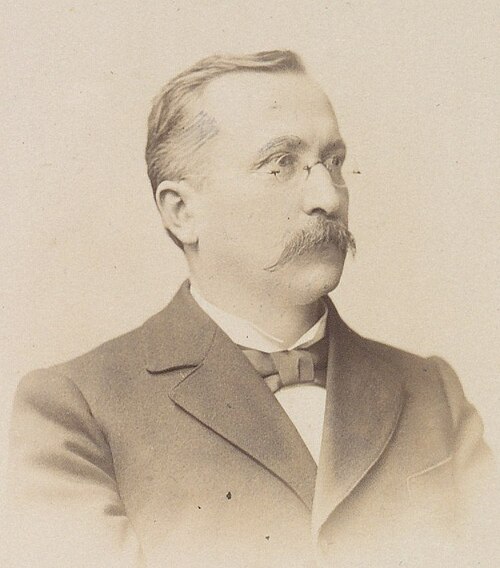

Wilhelm Roux
Roux killed one of the first two cleavage cells of a frog's egg with a hot needle and saw the survivor often grow into a half-embryo23. Later authors read this as support for organ-forming regions in the egg1. Others disputed that reading, and Roux rejected the preformationist label5.
- Born
- 9 June 1850
- Died
- 15 September 1924
- Country
- Duchy of Saxe-Weimar-Eisenach
- Field
- biologist, zoologist, university teacher
- In the library
- 0 works, named in 12 passages elsewhere
The half-embryo experiment
Roux plunged a hot needle into one of the first two blastomeres of the frog's egg. As a rule the surviving cell developed into only a half-embryo, with one half of the body missing34. Verworn reported that the missing half could later appear by what Roux called post-generation2. Loeb called the result classical. He noted that O. Schultze, who turned the egg upside down at the two-cell stage, obtained two whole embryos. Loeb explained this by a flow of protoplasm that Roux's setup had avoided4.
Preformation and its critics
Verworn placed Roux with Weismann among the defenders of organ-forming germ regions in the egg1. Roux protested against being called a preformationist. Verworn kept his judgment and quoted Roux's own words so readers could decide5. Child said Roux proposed qualitative nuclear division to account for orderly differentiation, and Weismann adopted it. Experiments by Driesch and many others later led Roux to abandon the hypothesis6. Child also said Roux gave regulation a physicochemical basis but framed it in a preformistic theory of heredity7.
Regeneration by rearrangement
Morgan cited Roux on regeneration of pieces of hydra. A piece takes no food while it regenerates, so Roux argued that the cells already present must rearrange. Roux compared this to the post-generation of a sea-urchin blastula piece. He concluded that regeneration may proceed largely by rearrangement and re-differentiation of cells, with little or no proliferation8.
Roux ('95) and Weismann ('92, 2) are the latest defenders of this view, which affirms that different areas are present in the egg
Verworn, M., 1899 · General Physiology: An Outline of the Science of Life · open at passage 1350in which he observed that after artificial destruction of one of the first two cleavage-cells, from the other at first only halfembryos developed
Verworn, M., 1899 · General Physiology: An Outline of the Science of Life · open at passage 1350Roux carried out his experiment by plunging a hot needle into one of the first two blastomeres, so that it is injured to such an extent
Morgan, T. H., 1901 · Regeneration · open at passage 556Roux destroyed one of the two first cleavage cells of a frog's egg with a hot needle and found that as a rule the surviving cell developed into only a half-embryo.
Loeb, J., 1916 · The Organism as a Whole, from a Physicochemical Viewpoint · open at passage 230Since Roux has protested against being reckoned among the preformationists, where he has been placed not only by myself, but by many
Verworn, M., 1899 · General Physiology: An Outline of the Science of Life · open at passage 1354Roux advanced the hypothesis of qualitative nuclear division as a basis for the orderly and harmonious differentiation of parts and Weismann adopted the idea.
Child, C. M., 1924 · Physiological Foundations of Behavior · open at passage 74According to Roux regulation has a physicochemical basis and is dependent upon physiological correlation, but his interpretation is in terms of a preformistic theory of heredity
Child, C. M., 1924 · Physiological Foundations of Behavior · open at passage 552regeneration may be brought about entirely, or very largely, through the rearrangement and re-differentiation of cells without any, or with very little, proliferation taking place.
Morgan, T. H., 1901 · Regeneration · open at passage 49