William Bateson
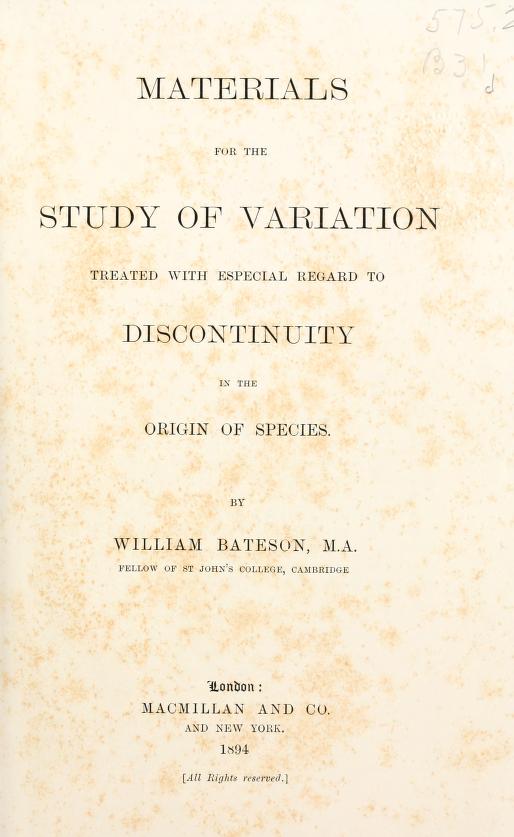
Bateson argued that arguments about evolution needed a body of observed variations, not guesses about what variation might do. His 1894 Materials collected recorded departures from the normal form in many animals12. Later authors linked them to Mendelian heredity4, to discontinuous change set against Darwin5, and to a rare physical suggestion about eye-spots7.
- Born
- 8 August 1861
- Died
- 8 February 1926
- Country
- United Kingdom of Great Britain and Ireland
- Field
- geneticist, biologist
- In the library
- 1 work, named in 12 passages elsewhere
- Facts from
- Wikidata · Wikipedia · Open Library
Facts of variation
Bateson proposed the study of variation as the best way to make a new start in evolutionary thinking1. Where others said that a variation might occur, he wanted a recorded case to cite. He also complained that known cases were neglected. Variations in the crayfish and the cockroach had been published in 1848, yet teachers and text-books ignored them2. His Materials follows this plan with individual cases. One is a heifer whose udder was intermediate between four teats and six3.
Heredity and discontinuity
Loeb credited Bateson and his pupils with showing that Mendel's law applies widely to heredity. He treated this, with de Vries's mutations, as a basis for evolution theory4. Rádl read Bateson's work on discontinuity as a return to the older view that species are more than convenient groupings. In his account Bateson did not see that this opposed Darwin5. Rádl also noted that Bateson and Korschinsky took their data from books, while de Vries worked by experiment6.
Later use and dispute
Thompson praised Bateson's discussion of the ocellus and noted that Bateson rarely suggested a purely physical cause. Here Bateson compared the rings of Morpho to concentric waves from one central disturbance7. Lotka quoted Bateson's review of Willis's Age and Area. Bateson doubted that endemic species are mostly new, since endemics are partly novelties and partly relics, and many species have died out8.
For the reasons set forth in the Introduction I suggest that for this newstart the Study of Variation offers the best chance.
Bateson, W., 1894 · Materials for the Study of Variation Treated with Especial Regard to… · open at passage 4though Desmarest and Brisout published the facts so long ago as 1848, their observations failed to get that visa of the text-books without which no fact can travel far.
Bateson, W., 1894 · Materials for the Study of Variation Treated with Especial Regard to… · open at passage 12The sketch given in Fig. 32, I. was taken from a heifer having an arrangement intermediate between the condition with four teats and that with six.
Bateson, W., 1894 · Materials for the Study of Variation Treated with Especial Regard to… · open at passage 589The discovery of DeVries, that new species may arise by mutation and the wide if not universal applicability of Mendel's law to phenomena of heredity, as shown especially by Bateson and his pupils
Loeb, J., 1912 · The Mechanistic Conception of Life · open at passage 407He did not realize that his point of view was directly opposed to that of Darwin, and that his theories represent a return to the earlier belief, that species are something more than 'aggregates of conveni- ence' of similar forms.
Rádl, E., 1930 · The History of Biological Theories · open at passage 783While Bateson and Korschin- sky took their data from books, De Vries attacked the problem experimentally.
Rádl, E., 1930 · The History of Biological Theories · open at passage 784This, by the way, is one of the very rare cases in which Bateson appears inclined to suggest a purely physical explanation of an organic phenomenon
Thompson, D. A. W., 1992 · On Growth and Form · open at passage 960Professor Bateson in the review already quoted remarks pointedly: ‘On any theory of evolution endemics (and rare species) must be in part novelties and in part relics
Lotka, A. J., 1925 · Elements of Physical Biology · open at passage 704