- In the library
- 1 work, named in 1 passages elsewhere
- Facts from
- Open Library
Evolution as a physical system
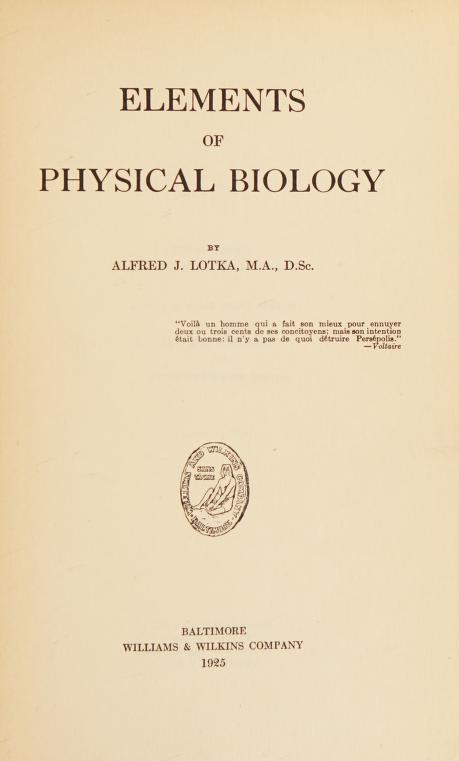
In the preface Lotka credits the influence and teaching of Poynting for whatever merits the book has2. The passages held here do not say more about how that influence shaped the argument.
Data from agriculture and geochemistry
The book draws on measured quantities from outside the laboratory. One passage uses University of Missouri feeding bulletins on steers. It compares animals fed for maximum growth without fat storage with animals somewhat underfed4. Another passage takes up the carbon cycle and Arrhenius's estimate of how much carbon dioxide the sea absorbs. Lotka states that no certain knowledge exists about whether the cycle shows a net balance5. Lotka also notes the opposing view, in which the end of volcanism would end life.
Use by Lillie
Lillie, writing on protoplasmic and nervous action in 1923, called trigger action a characteristic feature of all modes of organic response. He pointed readers to Lotka's discussion of natural selection as a physical principle, published in 1922 in the Proceedings of the National Academy of Science1. Lillie called that discussion interesting.
which is a characteristic feature of all modes of organic response (cf. the interesting discussion of Lotka:
Lillie, R. S., 1923 · Protoplasmic Action and Nervous Action · open at passage 442Whatever merits this book possesses may well be credited to the influence and teaching of Poynting.
Lotka, A. J., 1925 · Elements of Physical Biology · open at passage 4Evolution Defined: The History of a System in the Course of Irreversible
Lotka, A. J., 1925 · Elements of Physical Biology · open at passage 12Animals of group II were fed to secure maximum growth without storage of surplus fat. Animals of group III were somewhat underfed, to represent animals not properly cared for.
Lotka, A. J., 1925 · Elements of Physical Biology · open at passage 348As to which side of the account shows a net balance, in the carbon cycle, we have no certain knowledge.
Lotka, A. J., 1925 · Elements of Physical Biology · open at passage 522