Charles Manning Child
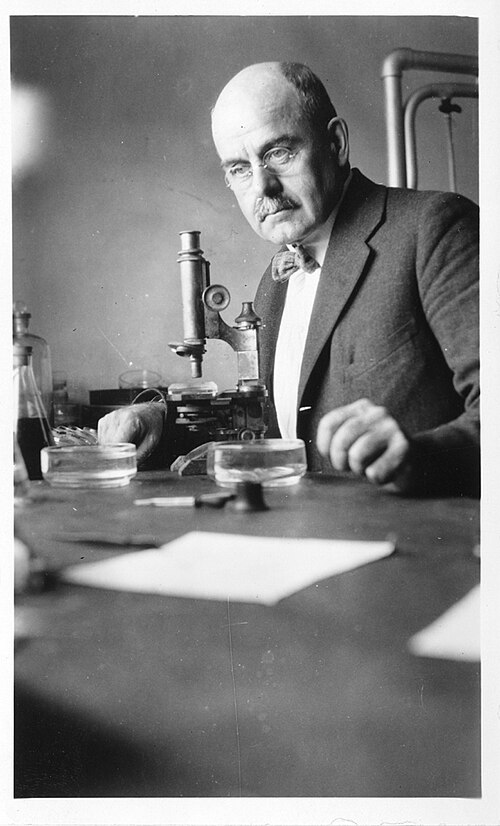
Child worked on the individuality of organisms and set out a mechanistic view under which individuality can be studied by scientific methods1.
- Born
- 2 February 1869
- Died
- 19 December 1959
- Country
- United States
- Field
- zoologist
- In the library
- 2 works, named in 9 passages elsewhere
- Facts from
- Wikidata · Wikipedia · Open Library
Gradients and polarity
Crile reports that Child showed experimentally, by testing susceptibility to poisons and narcotics, that gradients exist along the main axes of whole organisms and of single cells4. Crile adds that Child saw such gradients as a possible expression of functional polarity, in some cases perhaps only a graded difference in metabolic rate. In the 1924 book, polarity and symmetry are described as non-specific, quantitative regional differences within a specific protoplasm5. Because the axis is a gradient, it can be altered or removed by many different agents, according to how susceptible each level is5.
Age and disintegration
Loeb records that Child used rapid disintegration of tissue without oxygen, or with cyanide, as a general test. Younger animals disintegrated faster than older or larger ones, and Child built a theory of senescence on this2. Loeb did not doubt the observations but disputed the reading. He suggested that softer membranes in the young, perhaps linked to chemical constitution such as calcium content, could explain the faster disintegration without a higher metabolism3.
Behavior and later use
The 1924 book was planned with a colleague as one of two companion works, this one on the general physiological foundations of behavior and the other on neurological foundations8. Later writers kept returning to Child's ideas. A planarian regeneration review lists Child's gradient model among the historical gradient models that preceded positional information theory6. Levin cites Child's 1915 book when arguing that organism status, like cognition, is not a binary property7.
According to this last purely mechanistic conception the problem of individuality is accessible to scientific investigation and may be solved by scientific methods.
Child, C. M., 1915 · Individuality in Organisms · open at passage 12Child has used it to show that younger animals disintegrate more rapidly than older or larger ones, and he uses this fact for a theory of senescence.
Loeb, J., 1916 · The Organism as a Whole, from a Physicochemical Viewpoint · open at passage 548the writer is not quite certain whether the more rapid disintegration of the younger forms is not a result of the fact that the walls of membranes in the young are softer
Loeb, J., 1916 · The Organism as a Whole, from a Physicochemical Viewpoint · open at passage 548he has proved experimentally, by a study of susceptibility to the action of poisons and narcotics, that such gradients undoubtedly exist in the direction of the main axes, both in organisms as a whole and in individual cells.
Crile, G. W., 1926 · A Bipolar Theory of Living Processes · open at passage 307polarity and symmetry appear as non-specific or quantitative regional differentials in a specific protoplasm.
Child, C. M., 1924 · Physiological Foundations of Behavior · open at passage 283This idea was further developed in a series of historical models, including Child's gradient model (Child 1941)
Durant F, Lobo D, Hammelman J, Levin M, 2016 · Physiological controls of large-scale patterning in planarian regeneration: a… · open at passage 38cognition, like “organism status” (Child, 1915; Queller and Strassmann, 2009), is not a binary capacity that exists in higher organisms only
Levin M, 2019 · The Computational Boundary of a "Self": Developmental Bioelectricity Drives… · open at passage 4This collaboration has turned out to be the writing of two books, this one concerned with the general physiological foundations of behavior, the other, with the neurological foundations
Child, C. M., 1924 · Physiological Foundations of Behavior · open at passage 4