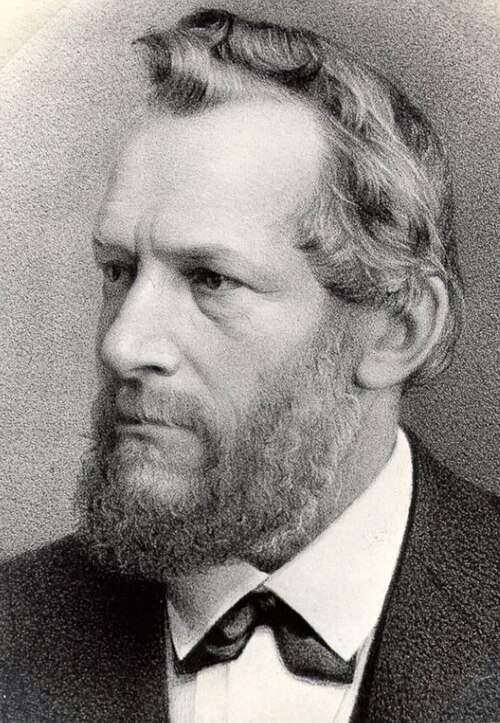
- Born
- 7 November 1818
- Died
- 26 December 1896
- Country
- Kingdom of Prussia
- Field
- physician, physiologist, university teacher
- In the library
- 1 work, named in 12 passages elsewhere
- Facts from
- Wikidata · Wikipedia · Open Library
The muscular current
The Abstract presents a law of muscle current that the author said explained all earlier cases of electromotive action in muscle, including Matteucci's latest statements and Volta's old remark about the tendon in Galvani's experiment1. From the law, any particle of a muscle, however small, should give a current like the whole muscle. The author published the law in January 1843 and claimed to have read the whole literature of electro-physiology and weighed it in the German work23.
Priority disputes
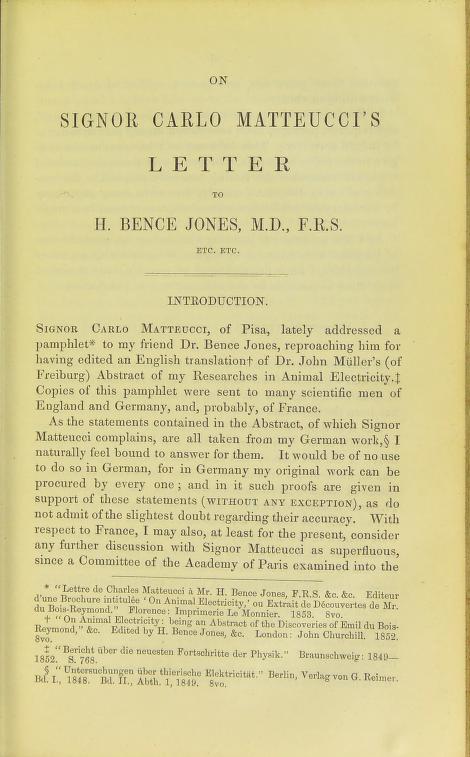
Matteucci attacked the author's results and claimed earlier papers, and the Abstract answers him point by point3. A footnote concedes a different point. Antonio Cima, in a paper of December 1844, had shown currents in undissected muscles and the equivalence of artificial transverse section and tendon expansion. The author said Cima would hold the discovery had the 1843 publication not existed, and noted that Matteucci himself granted Cima priority on those statements2.
Use and dispute by later authors
Verworn wrote that the work took a half-mystical field, one of the supports of vital force doctrine, and gave it a clear, exact foundation4. Bose reported the terms homodromous and heterodromous for polarising currents in the electrical organ5. He also reported that Hermann and Hering later showed what Du Bois-Reymond called positive polarisation to be excitatory reaction6. Lillie said the idea that local currents excite neighbouring tissue was tentatively expressed by Du Bois-Reymond. Morgan cited the dictum Ignorabimus as the view that some questions must remain unanswered7.
This very important law implied and explained at once all the cases of electro-motive action previously observed in muscles
Du Bois-Reymond, E. (ed. H. Bence Jones), 1852 · On Animal Electricity: Being an Abstract of the Discoveries of Emil du… · open at passage 34If the law of the muscular current had not been published by me in January, 1843, Signor Antonio Cima, of Cagliari, would be most entitled to its discovery.
Du Bois-Reymond, E. (ed. H. Bence Jones), 1852 · On Animal Electricity: Being an Abstract of the Discoveries of Emil du… · open at passage 52there is scarcely a single line, not only of Signor Matteucci's almost innumerable memoirs on animal electricity
Du Bois-Reymond, E. (ed. H. Bence Jones), 1852 · On Animal Electricity: Being an Abstract of the Discoveries of Emil du… · open at passage 12to place this field of physiology, which was then half-mystical and constituted one of the chief supports of the doctrine of vital force, upon a clear, exact foundation
Verworn, M., 1899 · General Physiology: An Outline of the Science of Life · open at passage 688Polarising-currents in the direction of the natural discharge of the organ are distinguished, in the terminology introduced by Du Bois-Reymond, as homodromous, and those in the opposite as heterodromous.
Bose, J. C., 1907 · Comparative Electro-Physiology: A Physico-Physiological Study · open at passage 630Hermann and Hering, however, afterwards showed that what Du Bois-Reymond called ‘ positive polarisation’ was in reality excitatory reaction.
Bose, J. C., 1907 · Comparative Electro-Physiology: A Physico-Physiological Study · open at passage 662which is interpreted to mean, not only that we are ignorant at present on certain questions, but that we know we must remain ignorant
Morgan, T. H., 1901 · Regeneration · open at passage 729