Current of injury
The current of injury, also called the injury current or demarcation current, is the electrical current found between injured and intact tissue. Du Bois-Reymond named its fall during muscle activity the negative variation.1 Later authors explained both effects through a polarised membrane.4 Recent reviews treat the current at a wound as a steady electrical field that accompanies regeneration.89
- Earliest held
- 1852, Du Bois-Reymond, E. (ed. H.…
- Most discussed in
- Response in the Living and Non-Living, 1902
- In the library
- 98 passages in 11 works
- Rewritten
- 2026-10-03
The negative variation named
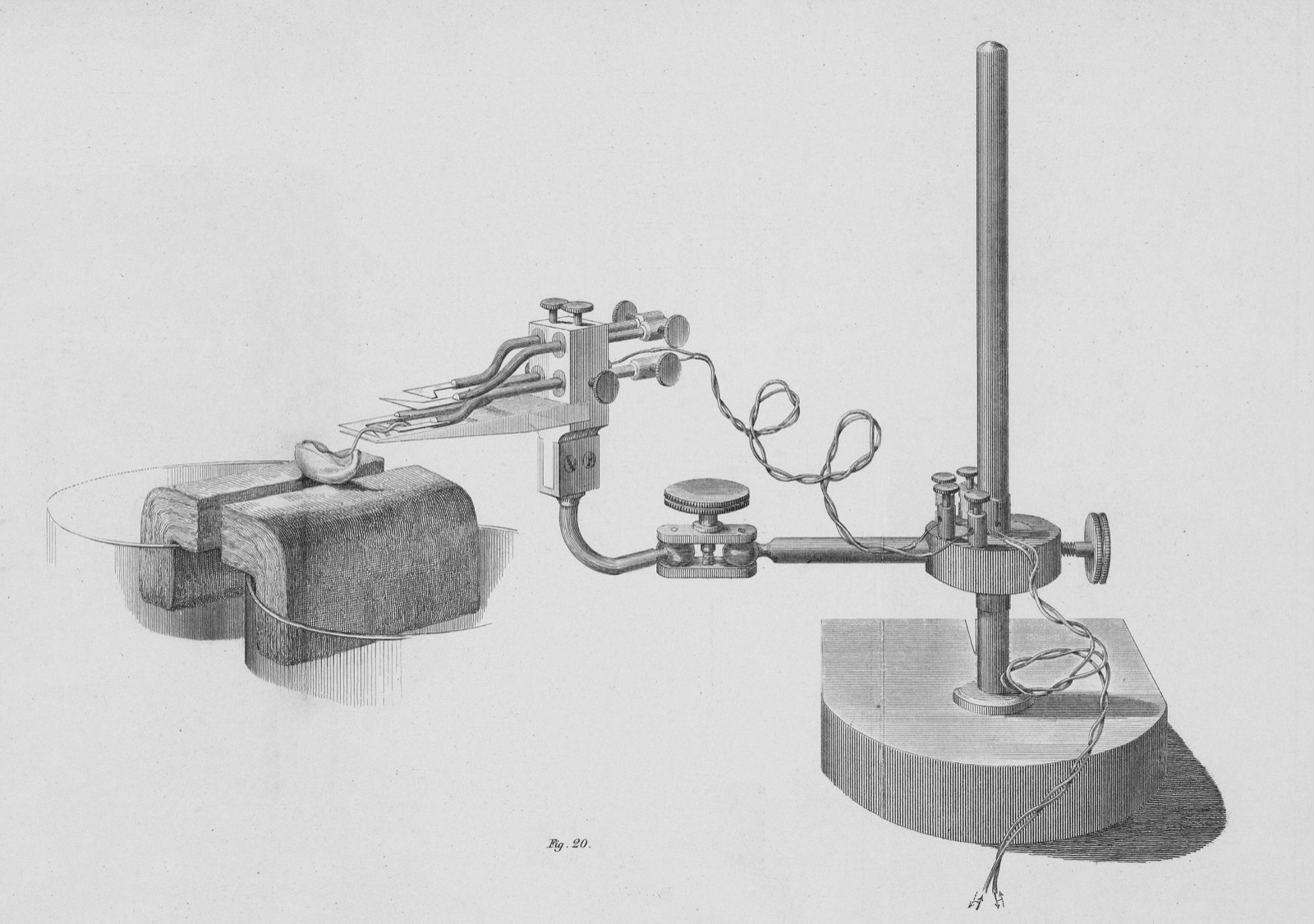

Du Bois-Reymond (1852) wrote of a "negative variation" of the muscular current during contraction. He preferred it to "decrease" because he could not yet tell whether the current only weakened or reversed its direction.1 He also discussed priority. He had first written that Matteucci stated the frog current disappears during tetanus, and had thought Matteucci observed the negative variation before him.2 He later judged that this wording did not do justice to his own work.2 A committee report quoted in the abstract called the negative variation a fundamental fact that directly explains Matteucci's induced contraction.2
Bose and the current of action
Bose (1902) described the same effect in nerve. Stimulation reduces an existing difference of potential, so the current of injury diminishes and the nerve shows a negative variation.3 He put this as a current of action that opposes the current of injury, running from the more excited to the less excited region.3 In 1926 he used the effect as a method in plants. Injuring the tissue at one electrode abolished its excitability, so the response at the other electrode appeared as a negative variation of the current of injury.7 He noted a complication. The injured tissue may recover, which reduces or removes the response, so a fresh injury has to be made.7
Membrane and ion accounts
Bayliss (1915) tied excitation to increased permeability of the cell membrane. If the membrane at rest is impermeable to only one ion of an electrolyte within the cell, it is polarised, and the current of rest, injury current or demarcation current is accounted for.4 If that semipermeability is lost in excitation, the negative variation follows.4 Lillie (1923) reported that Hober's salt experiments on muscle supported Overton's view that resting muscle is impermeable to sodium salts. Potassium, rubidium and ammonium salts produced an injury current or local negativity.5 Lillie gave 0.05 volt as the usual maximum variation in contraction, similar to the demarcation current. Some observers found the action current could reach 0.08 volt. He said the exact physico-chemical meaning could not yet be stated.6
Wounds and regeneration
Tyler (2017) reviewed work on voltage changes at wounds. Wounding human skin produces an ionic flux, the injury current, typically 1 to 10 μA/cm2.8 Amputated newt limbs showed 10 to 100 μA/cm2 in the remaining epidermis. Newly amputated human fingertips, which can regenerate, more usually in children, gave 22 μA/cm2.8 The review reports the suggestion that regenerating and non-regenerating systems differ in their bioelectric characteristics.8 O'Hara-Wright and colleagues (2022) describe the injury potential, or demarcation current, as a potential difference between intact epithelium and the wound. Current leaks from the wound edge, the path of least resistance, and creates an electrical field.9
because as yet I ha.ve not been able to make out whether during contraction there is only a decrease in the intensity of the current, or whether the direction of the current is reversed.
Du Bois-Reymond, E. (ed. H. Bence Jones), 1852 · On Animal Electricity: Being an Abstract of the Discoveries of Emil du… · open at passage 66Matteucci, in his ' Essai,' has stated that the frog current disappears DURING the tetanus.
Du Bois-Reymond, E. (ed. H. Bence Jones), 1852 · On Animal Electricity: Being an Abstract of the Discoveries of Emil du… · open at passage 72a ‘current of action’ was produced in response to stimulus, and acted in an opposite direction to the current of injury
Bose, J. C., 1902 · Response in the Living and Non-Living · open at passage 30the membrane is " polarised," and the " current of rest," " injury current," or " demarcation current," is accounted for.
Bayliss, W. M., 1915 · Principles of General Physiology · open at passage 1884salts like those of K, Rb and NH4 (which give other evidence of penetrating the muscle) produce an injury-current or local negativity.
Lillie, R. S., 1923 · Protoplasmic Action and Nervous Action · open at passage 279The maximum range of variation during contraction does not usually appear to exceed 0.05 volt, a potential-difference similar to that of the demarcation-current.
Lillie, R. S., 1923 · Protoplasmic Action and Nervous Action · open at passage 537a current of injury is produced, and the response at A is then observed as a negative variation of the current of injury. The injured tissue may, however, exhibit gradual recovery
Bose, J. C., 1926 · The Nervous Mechanism of Plants · open at passage 232Immediately upon wounding human skin, an endogenous ionic flux generates the so-called injury current, typically between 1 and 10 μA/cm2
Tyler SEB, 2017 · Nature's Electric Potential: A Systematic Review of the Role of Bioelectricity… · open at passage 19The TEPD at the site of injury falls and current “leaks” out from the wound edge, being the pathway of least resistance, creating an electrical field
O'Hara-Wright M, Mobini S, Gonzalez-Cordero A, 2022 · Bioelectric Potential in Next-Generation Organoids: Electrical Stimulation to… · open at passage 19
| 1902 | Response in the Living and Non-Living · Bose, J. C. | 37 |
| 1852 | On Animal Electricity: Being an Abstract of the Discoveries of Emil du… · Du Bois-Reymond, E. (ed. H. Bence Jones) | 17 |
| 1906 | Plant Response as a Means of Physiological Investigation · Bose, J. C. | 13 |
| 1915 | Principles of General Physiology · Bayliss, W. M. | 13 |
| 1923 | Protoplasmic Action and Nervous Action · Lillie, R. S. | 11 |
| 1926 | The Nervous Mechanism of Plants · Bose, J. C. | 2 |
| 2017 | Nature's Electric Potential: A Systematic Review of the Role of Bioelectricity… · Tyler SEB | 1 |
| 2022 | Bioelectric Potential in Next-Generation Organoids: Electrical Stimulation to… · O'Hara-Wright M, Mobini S… | 1 |
| 2012 | Modeling planarian regeneration: a primer for reverse-engineering the worm · Lobo D, Beane WS, Levin M | 1 |
| 1926 | A Bipolar Theory of Living Processes · Crile, G. W. | 1 |