- Born
- 30 November 1858
- Died
- 23 November 1937
- Country
- British Raj
- Field
- botanist, university teacher, physicist
- In the library
- 8 works, named in 9 passages elsewhere
- Facts from
- Wikidata · Wikipedia · Open Library
Stimulus and response
Bose held that plant movements were hard to analyse because internal energy and external stimulus were confused. He wrote that he could tell the characteristic expressions of the two apart1. In 1907 he restated an earlier argument. Internal stimulus, he said, came from external sources, so the term 'autonomous response' was a misnomer. Movements followed either immediate stimulus or stimulus the plant had absorbed and held latent2. In 1902 he reported response to electric stimulus in inorganic substances, first by conductivity variation3.
Excitation as physical
Child summarised Bose as arguing, from work on plants and metals, that excitation is fundamentally a molecular, physical disturbance4. Child set this beside other views of the period, such as Macallum's suggestion that nerve electricity arises from surface tension changes. Crile placed Bose after Burdon-Sanderson and Waller, who had shown electric variations in the Venus's Fly Trap and the Sensitive Plant. He credited Bose with evidence that vegetable and animal activity are identical and that electrical phenomena attend plant activity7.
Growth and later use
Thompson cited Bose for the finding that plant growth proceeds by small rhythmical pulsations a few seconds apart, shown by very refined methods5. Lillie reported that Bose found a polar effect of electric current on growth in higher plants. The anode enhanced the normal rate and the cathode depressed it6. Baluška and Levin described Bose as confirming and extending Darwin and Bernard. They noted that plant action potentials are still largely ignored by mainstream plant physiology8.
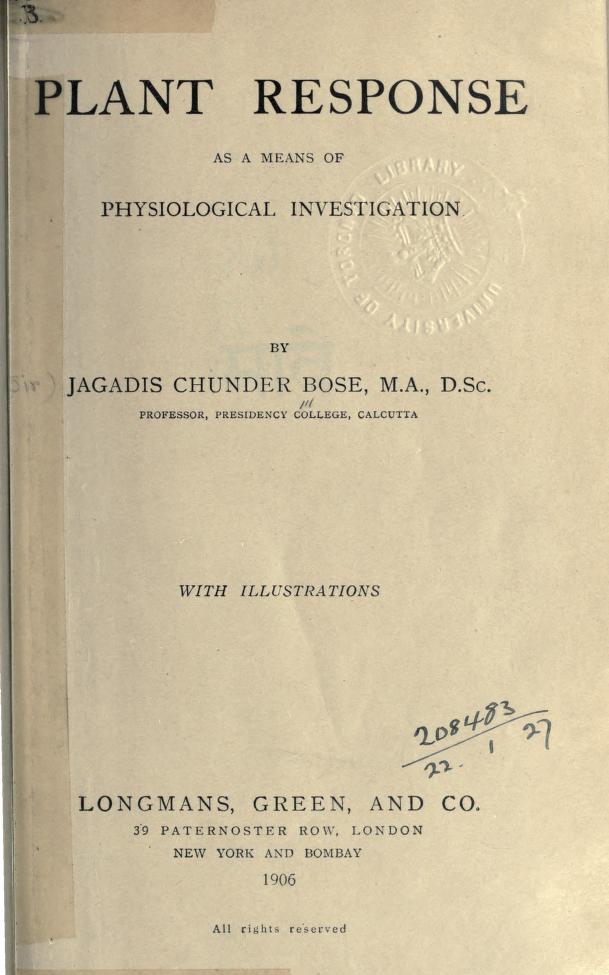
In analysing plant-movements the greatest complexity arises from the confusion of effects due to internal energy and external stimulus respectively.
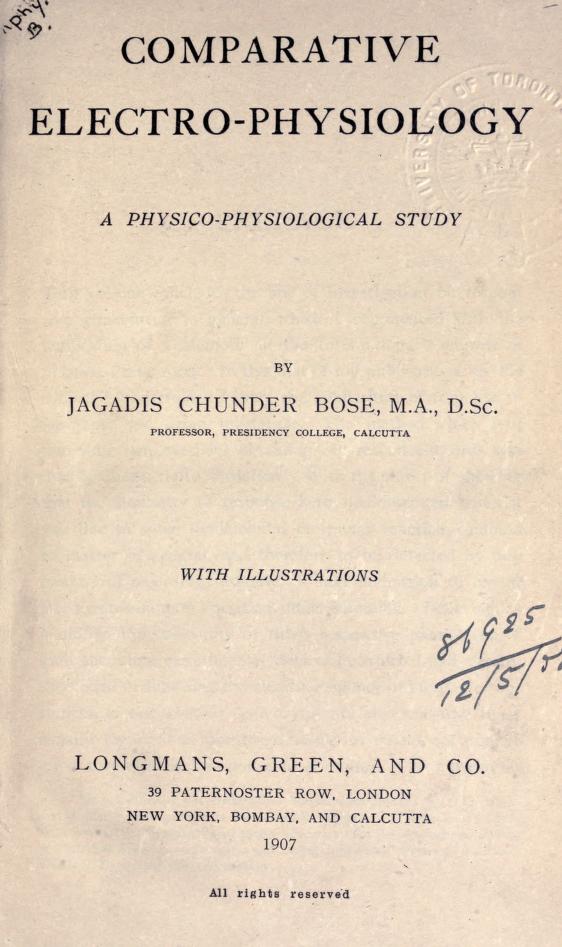
Bose, J. C., 1906 · Plant Response as a Means of Physiological Investigation · open at passage 4internal stimulus was in reality derived from external sources, and that the term ‘autonomous response’ was a misnomer, since all movements were due, either to the immediate effects of external stimulus
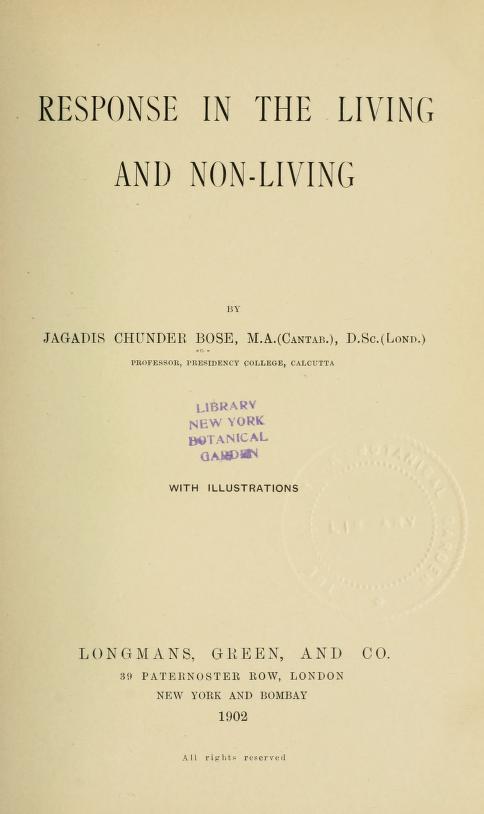
Bose, J. C., 1907 · Comparative Electro-Physiology: A Physico-Physiological Study · open at passage 4I obtained response to electric stimulus in inorganic substances using the method of conductivity variation
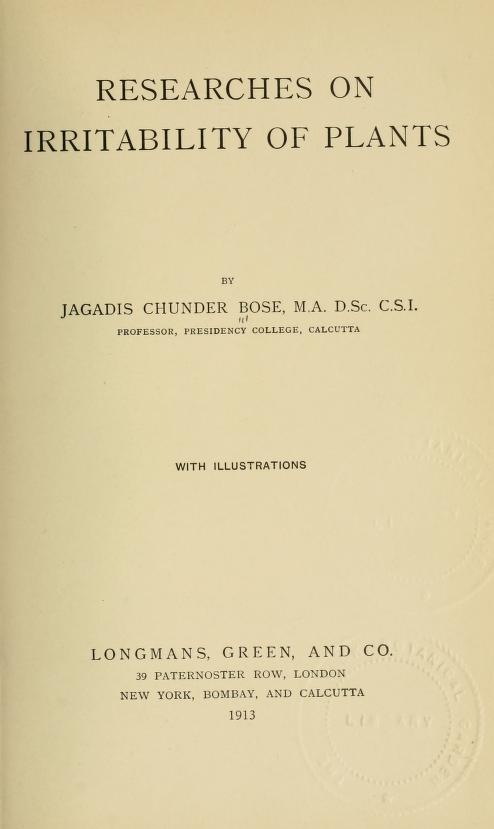
Bose, J. C., 1902 · Response in the Living and Non-Living · open at passage 159Bose (’02, ’06, ’07, ’13) on the basis of extensive investigation of the electrical features of response in plants and in metals, maintains that excitation is fundamentally a molecular, a physical disturbance.
Child, C. M., 1924 · Physiological Foundations of Behavior · open at passage 454Bose, by very refined methods of experiment, has shewn that plant-growth really proceeds by tiny and perfectly rhythmical pulsations recurring at regular intervals of a few seconds of time.
Thompson, D. A. W., 1992 · On Growth and Form · open at passage 219Bose has also found that the electric current influences growth processes in the higher plants in a polar manner, the anode enhancing and the cathode depressing the normal rate.
Lillie, R. S., 1923 · Protoplasmic Action and Nervous Action · open at passage 666has found evidence of the identity of vegetable and animal activity, and by most ingenious experiments has shown that electrical phenomena attend the activities of plants
Crile, G. W., 1926 · A Bipolar Theory of Living Processes · open at passage 80Later, Jagadis Bose accomplished his sophisticated experiments on plants, confirming and extending the previous results obtained by Charles Darwin and Claude Bernard
Baluška F, Levin M, 2016 · On Having No Head: Cognition throughout Biological Systems · open at passage 29
1902
1902 · read
1906
1906 · read
1907
1907 · read
1913
1913 · read
1918
1918 · read
1923
1923 · read
1927
1927 · read
1928
1928 · read