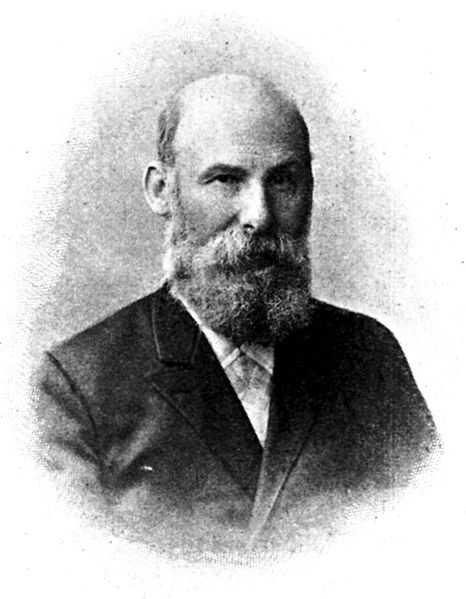
- Born
- 18 December 1839
- Died
- 6 February 1917
- Country
- Kingdom of Prussia
- Field
- physiologist, neuroscientist, university teacher
- In the library
- 1 work, named in 12 passages elsewhere
- Facts from
- Wikidata · Wikipedia · Open Library
The membrane theory
Lillie traces the membrane explanation of bioelectric potentials from Ostwald, followed by Cybulski, Bernstein and others. Bernstein took up Ostwald's idea of a membrane acting as an ion sieve. The aim was to explain the sudden fall of potential during stimulation1. At that stage Bernstein supposed the membrane became permeable to both classes of ions2. Lillie judges that real conditions are more complex than the simple diffusion potentials Ostwald and Bernstein considered3.
Experiments on nerve and muscle
Bose reports that Bernstein, working on the frog sciatic nerve, found that excitation produced a polarisation decrement4. Bayliss cites Bernstein (1908) on muscle. The maximal tension of a muscle was 375 g. at 0° and 205 g. at 18°. Bayliss took this negative temperature coefficient as evidence that surface tension changes help drive contraction5. Lillie also describes Bernstein's comparison of water evaporation through living and dead tissue6.
This hypothesis was adopted by Bernstein as affording a point of view from which the sudden fall of potential during stimulation might be explained
Lillie, R. S., 1923 · Protoplasmic Action and Nervous Action · open at passage 511at this time Bernstein supposed the membrane to become permeable to both classes of ions
Lillie, R. S., 1923 · Protoplasmic Action and Nervous Action · open at passage 511The actual conditions, however, are undoubtedly more complex, and include other factors than the simple diffusion potentials considered by Ostwald and Bernstein.
Lillie, R. S., 1923 · Protoplasmic Action and Nervous Action · open at passage 511Bernstein, experimenting on the sciatic nerve of frog, found that excitation induced a polarisation decrement.
Bose, J. C., 1907 · Comparative Electro-Physiology: A Physico-Physiological Study · open at passage 1303made practically certain by the observation of Bernstein (1908), who found that the maximal tension developed by a particular muscle, for example, was 375 g. at 0° and 205 g. at 18°
Bayliss, W. M., 1915 · Principles of General Physiology · open at passage 1945determined the relative rates of evaporation of water from living and dead tissues
Lillie, R. S., 1923 · Protoplasmic Action and Nervous Action · open at passage 239numerous inquirers, such as H. Munk, Hermann, Engelmann, Bernstein, and most recently Biedermann ('95), investigated the electrical phenomena of plants and various animal tissues
Verworn, M., 1899 · General Physiology: An Outline of the Science of Life · open at passage 688

