Galvanotaxis
Galvanotaxis is the directed movement of cells or animals in a galvanic current. Early physiologists studied it in free-living cells and small animals. Lillie argued that the direction of the current relative to the cell surface decides the physiological response.6 Later work calls the same behaviour in migrating tissue cells electrotaxis, and tests it in cancer cells, where responses differ between cell lines.8
- Earliest held
- 1899, Verworn, M.
- Most discussed in
- General Physiology: An Outline of the Science…, 1899
- In the library
- 108 passages in 16 works
- Rewritten
- 2026-10-03
Early observations
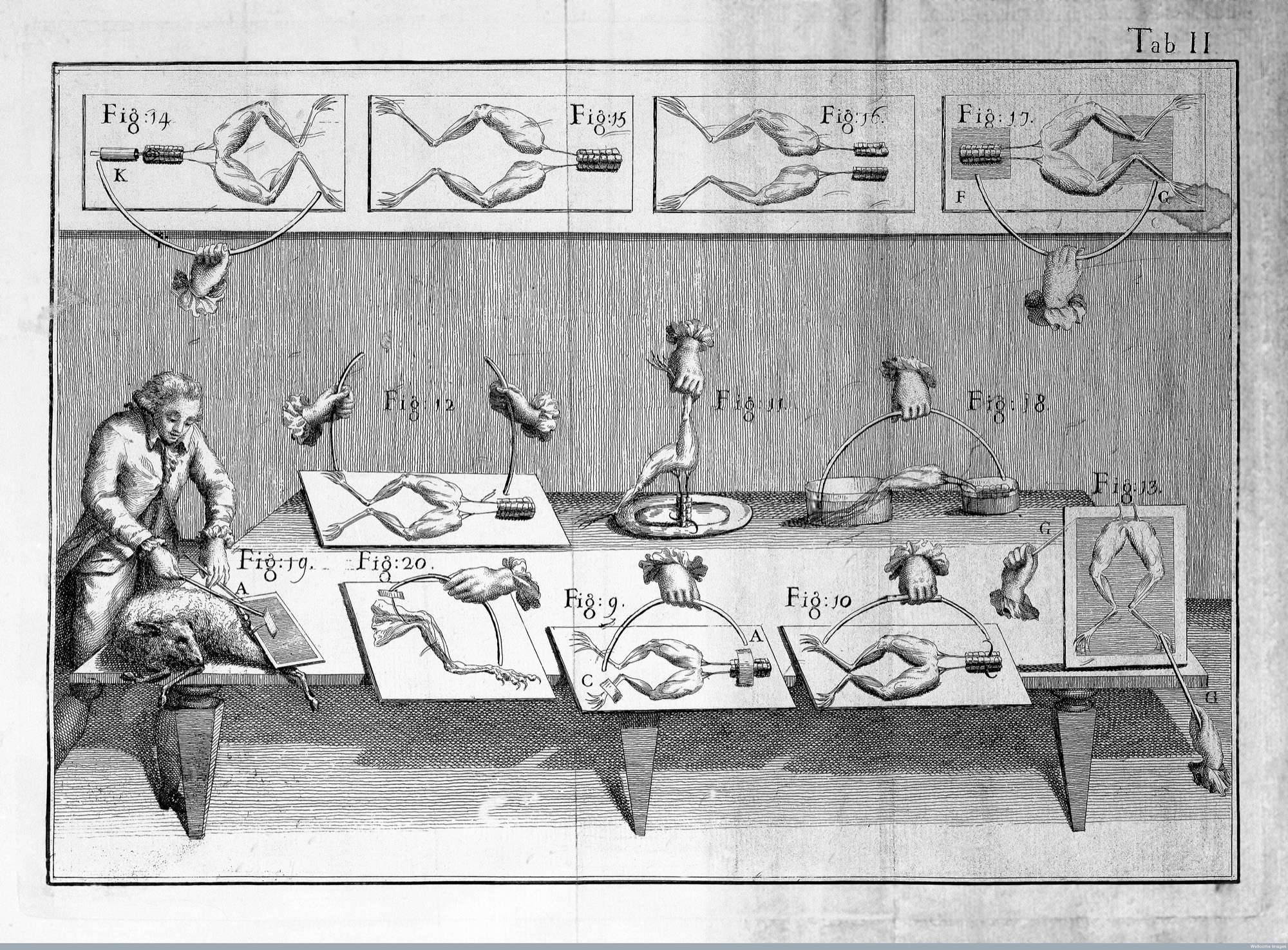

Verworn, in 1899, wrote that Kühne observed in 1864 that Actinosphaerium followed a very different law of excitation. The finding stayed isolated and unnoticed for more than two decades.1 It was recalled only after other effects of the galvanic current, which made up galvanotaxis, were discovered. A long series of free-living cells was then examined. Verworn said all of them followed a law of polar excitation that differed in several ways from that of nerve and muscle.1 Loeb described the plain laboratory result in 1912. Animals placed in a trough with a current through the water orient to its direction and move toward the positive or the negative pole.3
Loeb's ionic account
Loeb gave a physical account. Where current curves enter cells, ions collect and alter the chemical reactions. Current lines therefore play the part that light rays play in heliotropism.3 He added that light acts on the free surface of the animal, while current affects all cells and nerves. He used this to explain why fewer species show typical galvanotropism than show heliotropism.3 In 1916 he described the shrimp Palaemonetes, which is compelled toward the anode in dilute salt solution and can walk forwards, backwards or sideways.5 He also called galvanotropism purely a laboratory product, since almost no animal meets an electric current outside experiments, yet the reaction is common.4
Polarity and the limits of taxis
Lillie, in 1923, listed electrotonus, polar disintegration of cells, galvanotropic growth and galvanotaxis as processes showing polar action. In all of them the direction of the current relative to the cell surface decides the physiological effect.6 He compared this to electrolysis at an electrode, where the effect depends on whether current passes from metal to solution or the reverse.6 Driesch, in 1908, took a narrower view of taxis in general. Experiments in the style of Jennings had shown that chemicals, heat, light and contact do not produce taxis. He named galvanotaxis as the exception and expected the range of taxis to prove very restricted.2
Modern electrotaxis
Funk, in 2015, reviewed in vitro work in which many cell types migrate to the cathode in applied fields of about 0.1 to 10 V/cm. Examples include neural crest cells, fibroblasts and keratinocytes.7 Fewer types, such as corneal endothelial cells and human granulocytes, move to the anode. Both speed and direction depend on voltage.7 Sun, in 2017, reviewed microfluidic chambers and described work by Djamgoz and colleagues. Highly metastatic rat prostate cancer MAT-LyLu cells moved to the cathode, while weakly metastatic AT-2 cells did not respond.8 Sheth and Esfandiari, in 2022, reported that metastatic sublines of 4T1 differed in threshold. The parental and lung lines responded at 50 mV/mm, while others moved to the anode at 100 mV/mm or higher.9
In the year 1864 Kiihne made the peculiar observation that Actinosphcerium EichJiornii (Fig. 198) obeys a very different law of excitation.
Verworn, M., 1899 · General Physiology: An Outline of the Science of Life · open at passage 1049Therefore, though we cannot say at present that no case whatever of " taxis " exists (except galvanotaxis)
Driesch, H., 1908 · The Science and Philosophy of the Organism · open at passage 43In galvanotropism the current lines or the current curves play the same role as the light rays in heliotropism. At those points where the current curves enter the cells^ a collection of ions takes place which influences the chemical reactions.
Loeb, J., 1912 · The Mechanistic Conception of Life · open at passage 91Galvanotropism is, however, purely a laboratory product. With the exception of a few individuals, which have in recent years fallen into the hands of physiologists
Loeb, J., 1912 · The Mechanistic Conception of Life · open at passage 92When the shrimp Pal&monetes is put into a trough with dilute salt solution through which a current of a certain intensity flows, the animal is compelled to move towards the anode.
Loeb, J., 1916 · The Organism as a Whole, from a Physicochemical Viewpoint · open at passage 427All of these phenomena show that the direction of the current, relatively to the cell surface, determines the nature of its physiological action.
Lillie, R. S., 1923 · Protoplasmic Action and Nervous Action · open at passage 470many cell types prefer to migrate to the cathode when the externally applied field strengths is around 0.1–10 V/cm (electrotaxis)
Funk RH, 2015 · Endogenous electric fields as guiding cue for cell migration · open at passage 21The results indicated that rat prostate cancer MAT-LyLu cells (which are highly metastatic) exhibited strong electrotaxis by moving to the cathode, and rat prostate cancer AT-2 cells (which are weakly metastatic) showed no electrotactic behavior.
Sun YS, 2017 · Studying Electrotaxis in Microfluidic Devices · open at passage 6metastatic sublines (m4T1) from lung, heart, axillary lymph node and spleen showed different galvanotaxis thresholds.
Sheth M, Esfandiari L, 2022 · Bioelectric Dysregulation in Cancer Initiation, Promotion, and Progression · open at passage 25
| 1899 | General Physiology: An Outline of the Science of Life · Verworn, M. | 49 |
| 2017 | Studying Electrotaxis in Microfluidic Devices · Sun YS | 15 |
| 1906 | Plant Response as a Means of Physiological Investigation · Bose, J. C. | 8 |
| 1924 | Physiological Foundations of Behavior · Child, C. M. | 7 |
| 1912 | The Mechanistic Conception of Life · Loeb, J. | 6 |
| 1916 | The Organism as a Whole, from a Physicochemical Viewpoint · Loeb, J. | 5 |
| 1906 | Behavior of the Lower Organisms · Jennings, H. S. | 4 |
| 2015 | Endogenous electric fields as guiding cue for cell migration · Funk RH | 3 |
| 1908 | The Science and Philosophy of the Organism · Driesch, H. | 3 |
| 1923 | Protoplasmic Action and Nervous Action · Lillie, R. S. | 2 |