Max Verworn
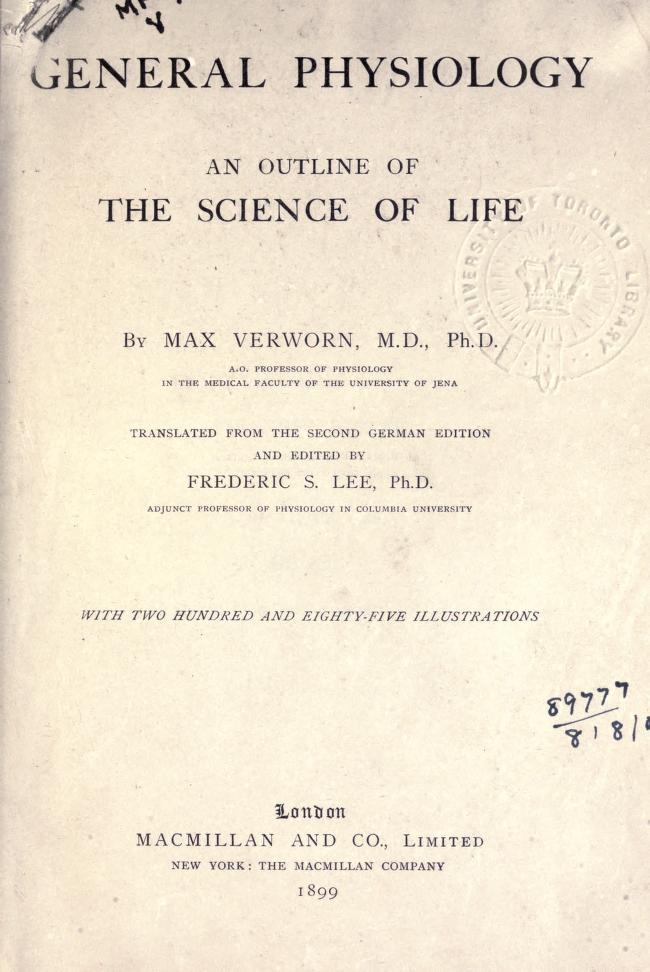
Verworn was a physiologist who worked on single-celled organisms and described excitation as a change in the rate of metabolism. He tested how the rhizopod Difflugia handles building material, studied protozoa cut into pieces, and reported their polar response to electric current.134 His 1899 textbook gave a general theory of stimulus and response.56
- Born
- 4 November 1863
- Died
- 23 November 1921
- Country
- German Reich
- Field
- physiologist, university teacher, paleontologist
- In the library
- 1 work, named in 12 passages elsewhere
- Facts from
- Wikidata · Wikipedia · Open Library
Experiments on protozoa
Binet cited Verworn's observations on Difflugia as evidence of instinct in rhizopods. Verworn placed fragments of coloured glass around the animal and later found a heap of them at the bottom of the shell.1 Thompson notes that Rhumbler imitated the shell with oil and sand, and that Verworn was careful not to overstate any sign of choice.2 Morgan reports that Verworn obtained results like Balbiani's: pieces of protozoa without a nucleus failed to regenerate.3 Bose adds that Verworn and others found polar effects in protozoa opposite to those in animal tissue, with the anode exciting at make.4
Tropisms and excitation
Jennings quoted Verworn's 1899 statement that chemotaxis, thermotaxis, phototaxis and galvanotaxis follow mechanically from differences in biotonus produced by stimuli at two poles of the cell.5 Child described Verworn's view that excitation is an acceleration in the breakdown of labile protoplasmic molecules.6 Child judged this essentially correct for generalised protoplasm, as a rise in the rate of living. He added that excitation need not be the same in all protoplasms.7
Later assessment
Verworn, instead of grains of sand, placed small fragments of colored glass about the animal; some time afterwards, he noticed a heap of these fragments on the bottom of the shell.
Binet, A., 1888 · The Psychic Life of Micro-organisms: A Study in Experimental Psychology · open at passage 8Verworn was very careful not to overestimate the apparent signs of volition, or selective choice, in the little organism’s use of the material of its dwelling.
Thompson, D. A. W., 1992 · On Growth and Form · open at passage 1038Balbiani ('88) found that non-nucleated pieces of cytrostomum, trachelus, and protodon failed to regenerate, and Verworn ('89 and '92) obtained similar results on several other protozoa.
Morgan, T. H., 1901 · Regeneration · open at passage 164It has been found, however, by Kiihne, Verworn, and others, that in the case of the protozoa the polar effects are exactly the opposite ; that is to say, in these instances, it is the anode which excites at make.
Bose, J. C., 1906 · Plant Response as a Means of Physiological Investigation · open at passage 505follow with mechanical necessity as the simple results of differences in biotonus, which are produced by the action of stimuli at two different poles of the free-living cell
Jennings, H. S., 1906 · Behavior of the Lower Organisms · open at passage 758that of Verworn (713) asserts that excitation is fundamentally an acceleration in the rate of breakdown or protoplasmic molecules so labile that the excitatory process may be regarded as more or less explosive in character.
Child, C. M., 1924 · Physiological Foundations of Behavior · open at passage 457it appears to be true, essentially as Verworn (713, Chap. V) maintains, that excitation in general is primarily an acceleration in the rate of living
Child, C. M., 1924 · Physiological Foundations of Behavior · open at passage 471His book soon lost its original reputation; it exerted very little influence on the later developments of modern physiology.
Rádl, E., 1930 · The History of Biological Theories · open at passage 934