- Born
- 25 September 1866
- Died
- 4 December 1945
- Country
- United States
- Field
- evolutionary biologist, geneticist, zoologist
- In the library
- 1 work, named in 12 passages elsewhere
- Facts from
- Wikidata · Wikipedia · Open Library
Regeneration across animals
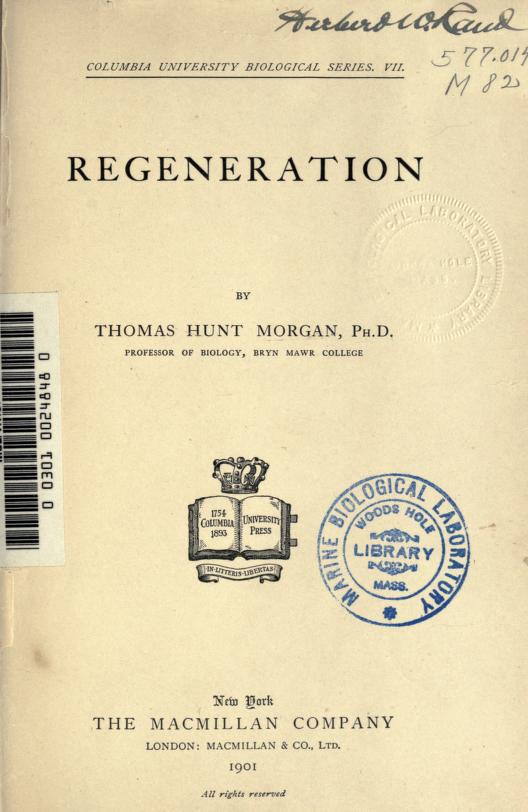
Regeneration covers many groups, from worms and hydroids to amphibians, and it includes chapters on grafting. Morgan retells Bonnet's experiment, in which a worm cut into up to fourteen pieces gave a new worm from each piece1. The book also notes that holothurians regenerate lost viscera in a very short time3. It reports that sea-urchins are an exception only because they have been studied less3.
Against selection of autotomy
Morgan tested the idea that natural selection explains the casting off of limbs. In the crab case, uninjured animals breed and resist enemies better than injured ones. Interbreeding between the two groups would give little or nothing, because on Darwinian principles intercrossing brings extreme variations back to the average2. The argument is aimed at the adaptive account of regenerative power.
Eggs, chromosomes and critics
Loeb reported that Morgan killed one of the first two cells of an egg and obtained half an embryo. When the egg was inverted and compressed, a half-size whole embryo formed4. Loeb also described Morgan's Drosophila crosses with white eyes, read in terms of the X chromosome6. He added that Morgan's group found four linkage groups, matching four chromosome pairs5. Child objected that this gave no theory of development, and that Morgan named regional cytoplasmic differences without explaining their origin78.
He found that if a worm is cut into three, four, eight, ten, or even fourteen pieces, each piece produces a new worm
Morgan, T. H., 1901 · Regeneration · open at passage 12Even if some of those that have been injured, and have thrown off the leg at the most advantageous place, should interbreed with the uninjured crabs, still nothing, or very little, can be gained
Morgan, T. H., 1901 · Regeneration · open at passage 403The holothurians have remarkable recuperative powers and may regenerate new viscera in a very short time.
Morgan, T. H., 1901 · Regeneration · open at passage 268He destroyed one-half of the egg after the first segmentation and found that the half which remained alive gave rise to only one-half of an embryo, thus confirming an older observation of Roux.
Loeb, J., 1912 · The Mechanistic Conception of Life · open at passage 383In Drosophila there are four pairs of chromosomes, and Morgan and his fellow-workers found only four groups of linked characters.
Loeb, J., 1916 · The Organism as a Whole, from a Physicochemical Viewpoint · open at passage 389Morgan interprets his experiments as follows. The normal redeyed Drosophila has one kind of eggs, each possessing one X chromosome.
Loeb, J., 1916 · The Organism as a Whole, from a Physicochemical Viewpoint · open at passage 323Morgan’s discussion of “The Organism as a Whole, or the Collective Action of the Genes” (Morgan, 719, pp. 241-246) does not provide us with any theory of development.
Child, C. M., 1924 · Physiological Foundations of Behavior · open at passage 75Morgan suggests the existence of regional cytoplasmic differences, but makes no attempt to account for the origin of such differences
Child, C. M., 1924 · Physiological Foundations of Behavior · open at passage 345