William Bayliss
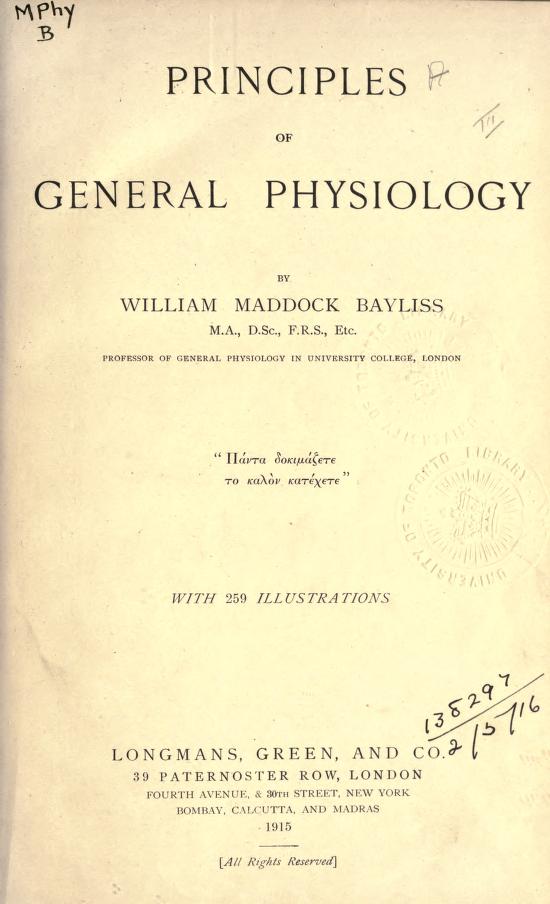
Bayliss wrote Principles of General Physiology (1915), which later authors cited as a general summary of cell membranes and colloid physics7. His work on interfaces and adsorption was followed by Lillie and Lotka12. He also named the hormone idea with Starling4 and devised a gum acacia solution for shock5.
- Born
- 2 May 1860
- Died
- 27 August 1924
- Country
- United Kingdom of Great Britain and Ireland
- Field
- physiologist, university teacher
- In the library
- 1 work, named in 12 passages elsewhere
- Facts from
- Wikidata · Wikipedia · Open Library
Colloids and interfaces
The Principles treats the physical chemistry of living matter, including the viscosity of two-phase systems. Bayliss reports that in emulsoids viscosity rises very rapidly above a certain concentration8. Lillie drew on a later paper by Bayliss. It gave cases in which adsorption comes first and true chemical combination follows2. Lotka expected physical chemistry to turn to structure, and named Bayliss's Interfacial Forces in Physiology as an example of that direction1.
Hormones and gum acacia
Thompson credits Bayliss and Starling with the word hormone for an internal secretion that regulates a function. Thompson applies it to the control of growth and form4. Crile, writing on the failing energy of the organism after hemorrhage or shock, tested a six per cent gum acacia solution made to the Bayliss formula. He noted that opinion on its value varied5.
Use by later authors
Osterhout sent readers to Bayliss (1915) for a general summary on the plasma membrane7. Crile listed Bayliss among those who held a Nernst-type view of nerve excitation by ion accumulation6. Bose quoted a warning from the physiology book. Descriptive names such as heliotropism can mislead, because they suggest that new knowledge has been gained3.
On the contrary, it is to be expected that the future will bring important developments in this direction, as followed, for example by Sir William Bayliss in his work Interfacial Forces in Physiology.
Lotka, A. J., 1925 · Elements of Physical Biology · open at passage 96In a recent paper^ Bayliss gives instances showing that in many reactions in polyphasic systems adsorption is the initial process which forms a necessary preliminary to the true chemical combination following.
Lillie, R. S., 1923 · Protoplasmic Action and Nervous Action · open at passage 140protests Bayliss in his book on physiology, ‘leading to the belief that new knowl¬ edge has been obtained when a phenomenon is described by a name derived from the classical tongue
Bose, J. C., 1927 · Plant Autographs and Their Revelations · open at passage 244some enzyme or “hormone” (as Bayliss and Starling call it), or “harmozone,” as Gley calls it in the particular case where the function regulated is that of growth
Thompson, D. A. W., 1992 · On Growth and Form · open at passage 319In view of the variance of opinion regarding the value of gum acacia (Bayliss) solution as a means of conserving the failing energies of the organism after hemorrhage or after shock
Crile, G. W., 1926 · A Bipolar Theory of Living Processes · open at passage 699supports Nernst's general theory; MeClendon,'* Bayliss," Lille!9 and others take a similar view.
Crile, G. W., 1926 · A Bipolar Theory of Living Processes · open at passage 83For a general summary see Bayliss (1915), Hober (1914), and McClendon (1917).
Osterhout, W. J. V., 1922 · Injury, Recovery and Death in Relation to Conductivity and Permeability · open at passage 440With emulsoids above a certain concentration, there is a very rapid rise of viscosity with further increase in concentration.
Bayliss, W. M., 1915 · Principles of General Physiology · open at passage 1087