Abstract
Actoprotection concerns the preservation of function under demanding conditions. This study examined whether archived pharmacological measurements support a more specific energetic account. We combined a source-anchored evidence analysis with a descriptive reanalysis of rat cortical perfusion and firing, and a conditional electrical-model experiment based on reported sodium and potassium current changes.
Some joint conductance changes reduced calculated sodium-restoration cost while retaining a defined electrical response. At the 100 µM source pattern, reductions were approximately 19–20% for Bemitil and 26–27% for Almide in the Hodgkin–Huxley model, with smaller reductions and a narrower retained range in the Wang–Buzsáki model. A separate source-table analysis found perfusion increasing more than sampled neuronal firing. Neither result establishes improved human endurance or reduced whole-cell ATP expenditure. They distinguish demand, delivery and recovery as mechanisms requiring separate tests.
Introduction
The historical definition of an actoprotector includes maintaining work capacity without a corresponding increase in oxygen consumption or heat production. That is a proposition to test, not a property automatically shared by every compound given the label. The category spans several chemical families and overlaps with antihypoxants and adaptogens.
A behavioural improvement and an energetic explanation do not identify the mechanism responsible. Altered current flow, greater oxygen delivery, preservation of cellular machinery and changes in central drive could each affect performance. Different compounds may act through different combinations of these routes.
We asked two quantitative questions. First, do reported supply-related and activity-related responses scale together? Second, can an observed pattern of current changes lower an ionic restoration cost while retaining evoked output? The first is a transformation of published measurements; the second is a conditional model experiment.
Methods
Evidence corpus and source checks
The exploratory analysis used a pre-existing pharmacological archive on 4 October 2026. Its acquisition history was incomplete, so the search was not exhaustive. Retrieval covered Bemitil, Bromantane, Ethomersol, Ademol and Chlodantane, supplemented by Almide and Tietazole aliases. Compound aliases supported retrieval without equating formulation masses or exposures.
The inventory contained 627 raw records and 542 canonical entries. Previously extracted material supplied 2,499 claims from 273 source documents. Source-location matching retained 2,327 claims and set aside 172 that failed the matching criterion. A matching quotation establishes where text came from; it does not establish the validity of its biological or causal interpretation.
Anchor reports were selected after source inspection for direct currents, pharmacokinetics, supply/activity, pump and redox recovery, central signalling and functional outcomes. AI-assisted triage and extraction were checked against available sources, without independent human adjudication of the classifications or bilingual review. Abstract-only and full-text records remained distinguishable. No meta-analysis, efficacy ranking or formal certainty score was calculated.
Neurovascular reanalysis
Four time-matched control and treated group means from a rat physiology report supplied cortical flow, oxygen tension, firing rate and stimulus-evoked hyperemia measures. We calculated treated/control ratios and a flow-to-firing index: the flow ratio divided by the firing ratio. The four times were not treated as independent experiments.
Regional flow and sampled neuronal firing measure different aspects of physiology. Their ratio is descriptive, not a tissue ATP budget. Individual-level covariance was unavailable, so no confidence intervals or significance tests were reconstructed. The source’s separate pharmacokinetic and physiology arms used different doses and were not combined.
Conditional electrical experiment
We implemented the single-compartment Hodgkin–Huxley squid-axon model (HH) and the isolated Wang–Buzsáki fast-spiking interneuron model (WB). They provide two electrical backgrounds; neither reconstructs the original molluscan preparation or represents mammalian neuron diversity.
Reported sodium and slow-potassium peak-current fractions from isolated Lymnaea stagnalis neurons were mapped to maximal-conductance multipliers. Voltage dependence, use dependence and changes in kinetics were not fitted. Transferring those ratios across preparations—and treating the source’s slow potassium current as the modelled delayed rectifier—is an unvalidated assumption. Calcium effects were not inserted into models without calcium channels.
All five reported source concentrations were retained. Each condition received twenty one-millisecond current pulses at 10, 40 or 80 Hz and 10, 20 or 40 µA/cm² after 200 ms of settling. Joint, sodium-only and potassium-only perturbations were compared on the same grid.
Output and cost definitions
A passing condition required exactly one spike per input, no additional spikes, no spontaneous spikes in the last 100 ms of settling, every peak excursion at least 90% of its matched control, and every latency within 2 ms of control. Controls that did not transmit one spike per input were ineligible for an equal-output cost comparison. Sensitivity analyses changed the peak/latency thresholds to 80%/3 ms and 95%/1 ms.
The primary cost was inward sodium charge above an otherwise identical resting trajectory, divided by twenty inputs and converted using three sodium ions restored per ATP. It is a sodium-restoration equivalent, not total cellular ATP expenditure. Potassium overlap was not counted as a second ATP term because its effect is already reflected in sodium entry. Total sodium load without resting-background subtraction was also retained.
The primary grid contained 558 conditions: eighteen controls and 540 perturbations. It was run at 0.01 ms and repeated at 0.005 ms. Twenty representative conditions were checked with a separately implemented adaptive solver. An additional exploratory grid of 1,024 input settings varied sodium and potassium effect strengths independently after inspection of the primary results. Ranges across settings describe deterministic sensitivity, not biological confidence intervals.
Results
Source currents and exposure
At 100 µM, the source table reports sodium, calcium and slow-potassium currents at 80%, 94% and 86% of control for Bemitil, and 75%, 90% and 75% for Almide. At 1,000 µM, suppression was stronger. The source describes rapid, reversible changes, but its two to four measurements per entry lack usable dispersion and clear independence. Current amplitudes alone do not measure energy use.
The human pharmacokinetic anchor reported a mean total-plasma peak of 0.91 µg/mL after an oral Metaprot dose, with substantial variation. Using the neutral analyte mass gives an illustrative concentration of approximately 5.1 µM. This is much closer to the source’s low-concentration range than to its marked blocking range. It is not a free-brain concentration or a direct clinical exposure comparison.
Lower calculated cost with retained output
Eight of nine control settings in each model transmitted all inputs. The 80 Hz, 10 µA/cm² setting failed that condition and remained in the recorded data but outside equal-output comparisons.
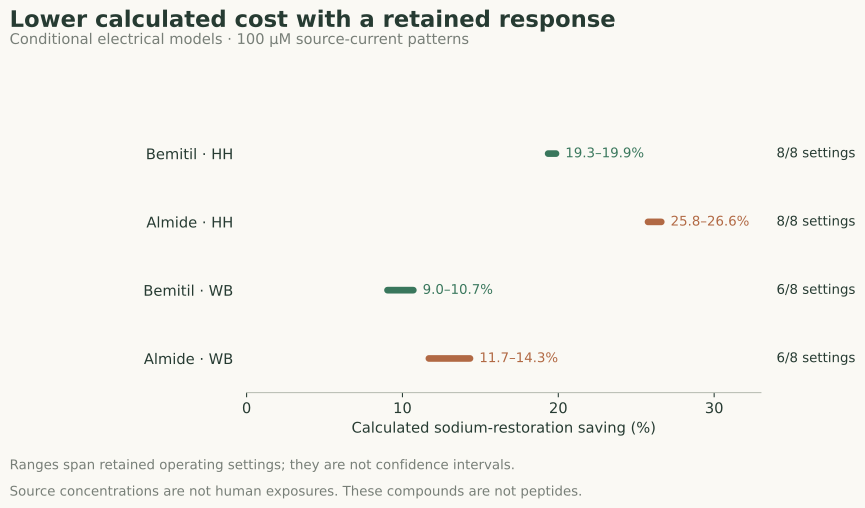
| 100 µM source pattern | HH cost reduction | HH retained | WB cost reduction | WB retained |
|---|---|---|---|---|
| Bemitil · Na 0.80 / K 0.86 | 19.3–19.9% | 8 / 8 | 9.0–10.7% | 6 / 8 |
| Almide · Na 0.75 / K 0.75 | 25.8–26.6% | 8 / 8 | 11.7–14.3% | 6 / 8 |
The two WB failures at this concentration retained spike counts but failed excursion and, for Almide, latency constraints at weaker inputs. Counting spikes alone would therefore overstate the retained operating range. A 20% sodium-conductance reduction also did not impose a 20% cost reduction in both models; changed voltage, gating and potassium countercurrent altered integrated sodium entry.
Suppression is not sufficient
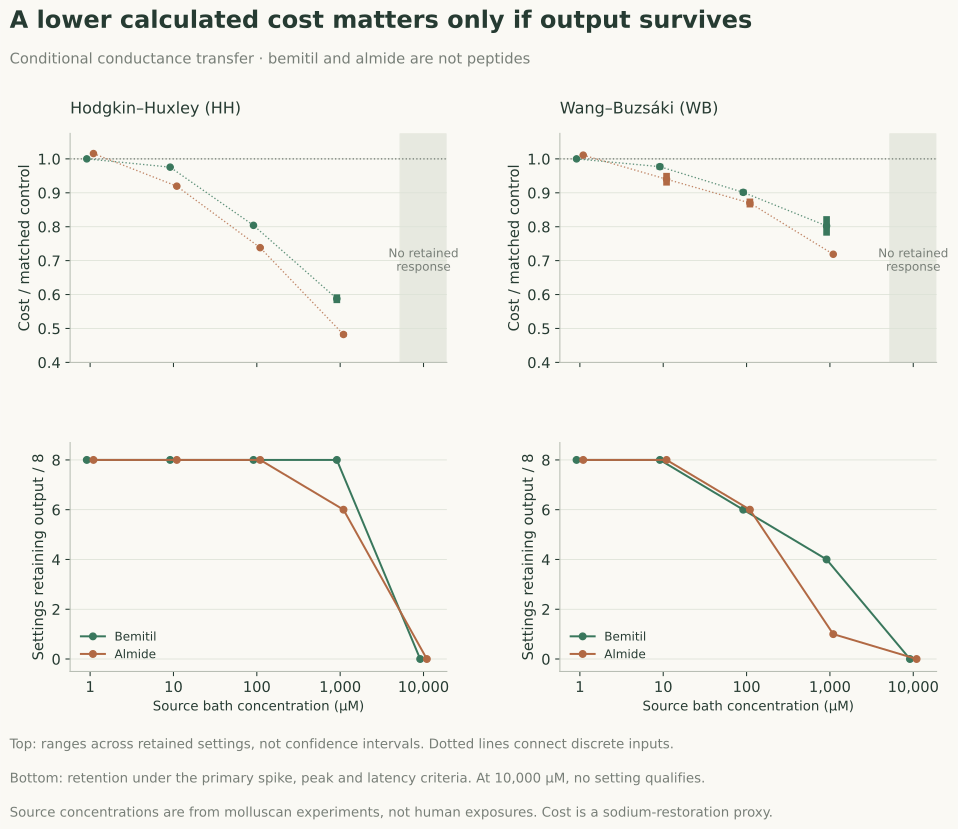
At the 1,000 µM Bemitil pattern, joint modulation retained eight eligible HH settings, sodium-only modulation five and potassium-only modulation none. In WB, the corresponding counts were four, three and eight. The consequence of suppressing potassium therefore depended on the electrical background.
Tightening the criterion to 95% excursion and 1 ms latency retained all eight HH settings at the 100 µM patterns, but only five WB settings for Bemitil and three for Almide. At 10,000 µM, neither compound retained output in either model. At 1 µM, Bemitil was unchanged and Almide slightly increased calculated cost. These results do not support a monotonic relationship between stronger inhibition and useful benefit.
Independent variation of sodium and potassium effect strength also produced regions where every input failed. Among retained settings, reductions could persist while their magnitude changed substantially. This sensitivity is part of the result, rather than experimental uncertainty around a single predicted drug effect.
Perfusion and firing did not rise proportionally
In the separate rat source-table analysis, flow increased approximately 2.53–2.55-fold while sampled firing increased 1.17–1.43-fold. The resulting flow-to-firing index ranged from 1.77 to 2.17. Stimulus-evoked hyperemia began approximately 43.5–47.5% sooner. Relative response amplitudes changed little, despite the higher baseline flow.
These group-mean calculations suggest a supply-related response worth testing. They do not demonstrate lower ATP cost per spike: oxygen consumption, oxygen extraction, synaptic activity and total tissue demand were unmeasured. The source contains inconsistent significance symbols and regression reporting; those claims were not reused as evidence of reliability.
Discussion
Demand, delivery and restoration
The model establishes a conditional possibility: coordinated conductance changes can lower an ionic restoration cost while preserving a bounded response. The rat reanalysis establishes a different observation: reported perfusion rose more than sampled activity. One result cannot validate the other, and their magnitudes must not be multiplied into a combined benefit.
A simple accounting relation clarifies the distinction. If sustainable ATP supply is S, background demand B, incremental cost per useful output q and output rate f, the remaining energetic margin is S − B − qf. This is a conceptual identity, not a fitted physiological model. A larger margin does not rescue a response lost to channel block. The simulations examine one component of q; blood flow is related to supply but does not directly measure S.
Other anchor reports concern preservation of redox and pump function after injury, vascular effects, or central signalling and plasticity. They motivate separate mechanisms. For example, restoration after intoxication cannot establish direct pump activation, and a plasticity endpoint cannot establish the pathway responsible for endurance. A functional category does not imply one shared molecular target.
What remains unresolved
The model does not measure ATP supply, injury, dynamic ion pools, oxygen extraction or whole-tissue energy use. It cannot distinguish a therapeutic demand-reduction mechanism from delivery or recovery effects. Its post-stimulus integration tail is charge accounting, not a recovery experiment.
Limitations
The archive was incomplete, anchor selection followed inspection and study-family deduplication was not exhaustive. An overlapping 2005 report cannot be counted as independent replication of the 2003 current observations. Several class members were represented by abstracts, and automated classifications were not independently human-adjudicated.
The current factors were transferred between species, cell types and potassium-current identities without validation. Kinetics and reversal potentials were fixed. Calcium, synapses, propagation, noise, network computation, mitochondria and pump dynamics were omitted. The input grid and output thresholds determine the retained range. Numerical agreement between time steps and solvers verifies the calculation, not this biological transfer.
The neurovascular calculations use ratios and products of published means without recoverable covariance, individual records or consistent statistical reporting. No source connects human exposure, matched useful output, complete ATP accounting and recovery well enough to identify a causal actoprotection mechanism.
Conclusion
The archival current patterns support a testable energetic hypothesis, with model-dependent limits on preserved function. The separate perfusion analysis supports investigation of a delivery route. Demand, delivery and restoration should be measured against retained function in the same experimental system before making a therapeutic or human-performance claim.
Research reading edition · 12 October 2026. AI assisted source work, analysis and preparation. The studies have not undergone external peer review.