A patch has to do more than enter skin
A needle can look successful in a microscope image and still fail as a delivery device. It may cross the skin with only a small part of its payload. It may leave material on the surface, soften before entry or lose biological activity during fabrication. An attractive puncture mechanism solves only part of this problem.
A dissolving vaccine patch must carry a defined formulation, survive manufacture and storage, withstand application, release material into an intended tissue region and leave a manageable used product. Its mechanical properties change during use. The dry structure must resist failure; after application, dissolution must proceed far enough to release the dose within the intended wear time.
A feeding apparatus, a defensive quill and an egg-laying organ operate under different constraints. A feature that improves one may be unnecessary—or troublesome—in another. A quill that is difficult to remove has achieved a defensive purpose. A vaccine patch requires enough contact to deliver its payload, followed by predictable removal of the backing. Those objectives can favour different structures.
Our comparison therefore asks three questions of each mechanism: what was measured, what equipment or material made it possible, and what would have to be demonstrated in a dissolving array? We use selected primary experiments, rather than treating the number of species with sharp structures as evidence for a particular design. The comparison concerns the published mechanisms and their constraints; it does not specify an Alterspan device.
What the mechanisms require
Support and motion: the mosquito and the wasp
A mosquito-inspired biopsy study by Li and colleagues (2020) tested movement between parts as well as needle shape. It compared direct insertion with alternating needle–cannula motion, then added notches to the needle tip. Mean forward speed was kept the same. The experiments tracked displacement in transparent, particle-filled phantoms.
In one phantom path, final displacement was 2.2 mm for direct insertion, 1.8 mm with alternating motion and 1.5 mm with the notched, alternating system. This is evidence about that biopsy arrangement, not a prediction for a skin patch. The notch advantage in the local displacement measurement also diminished near the end of insertion. The same geometry did not provide a constant benefit throughout the motion.
Watch the material move around the needle.
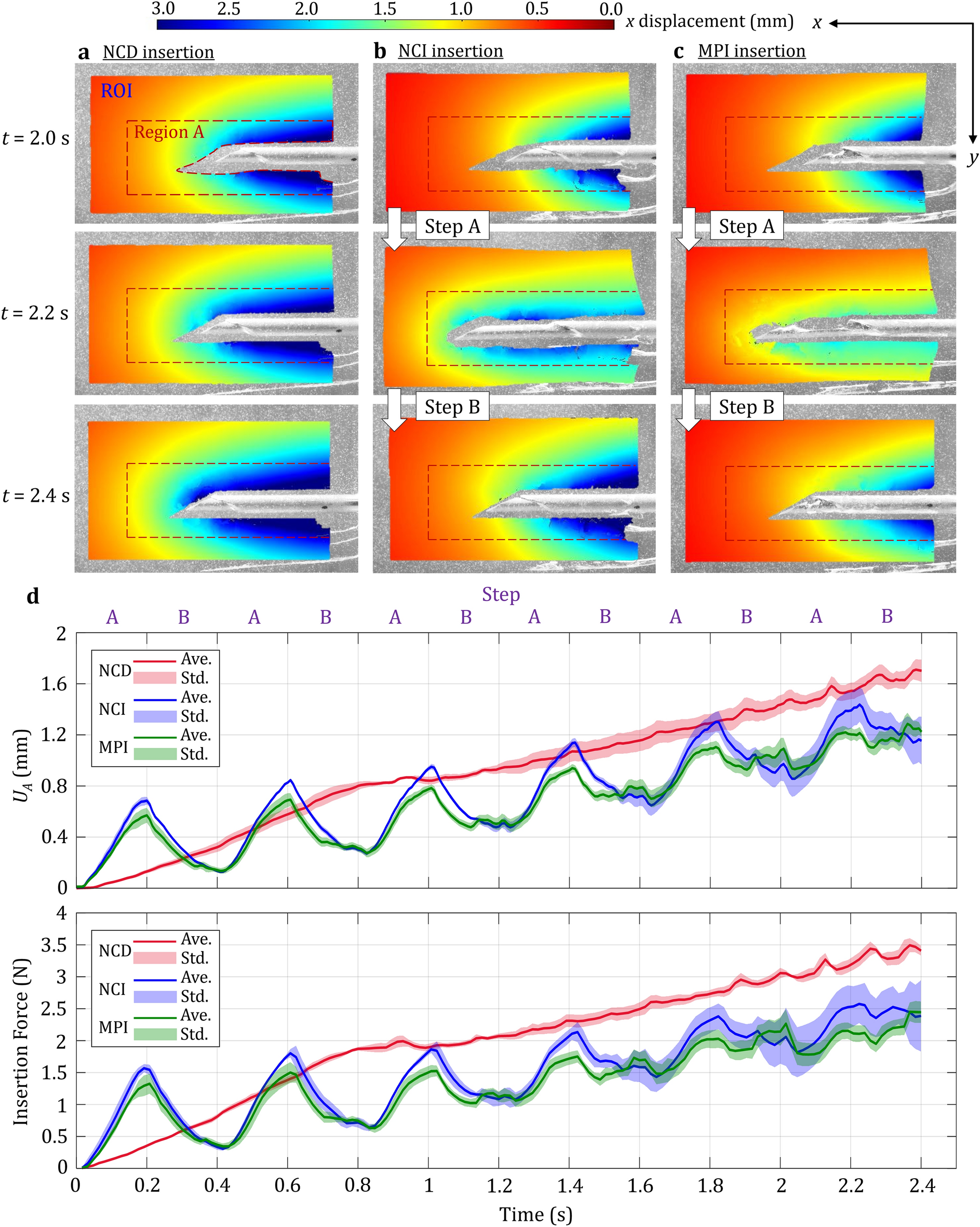
Read across: direct insertion (NCD), alternating needle and cannula (NCI), then alternating motion with a notched tip (MPI).
Read down: three moments during insertion. Blue marks greater displacement; red marks less. The lower plots show that the advantage changes during the motion.
See the needle design and biopsy set-up
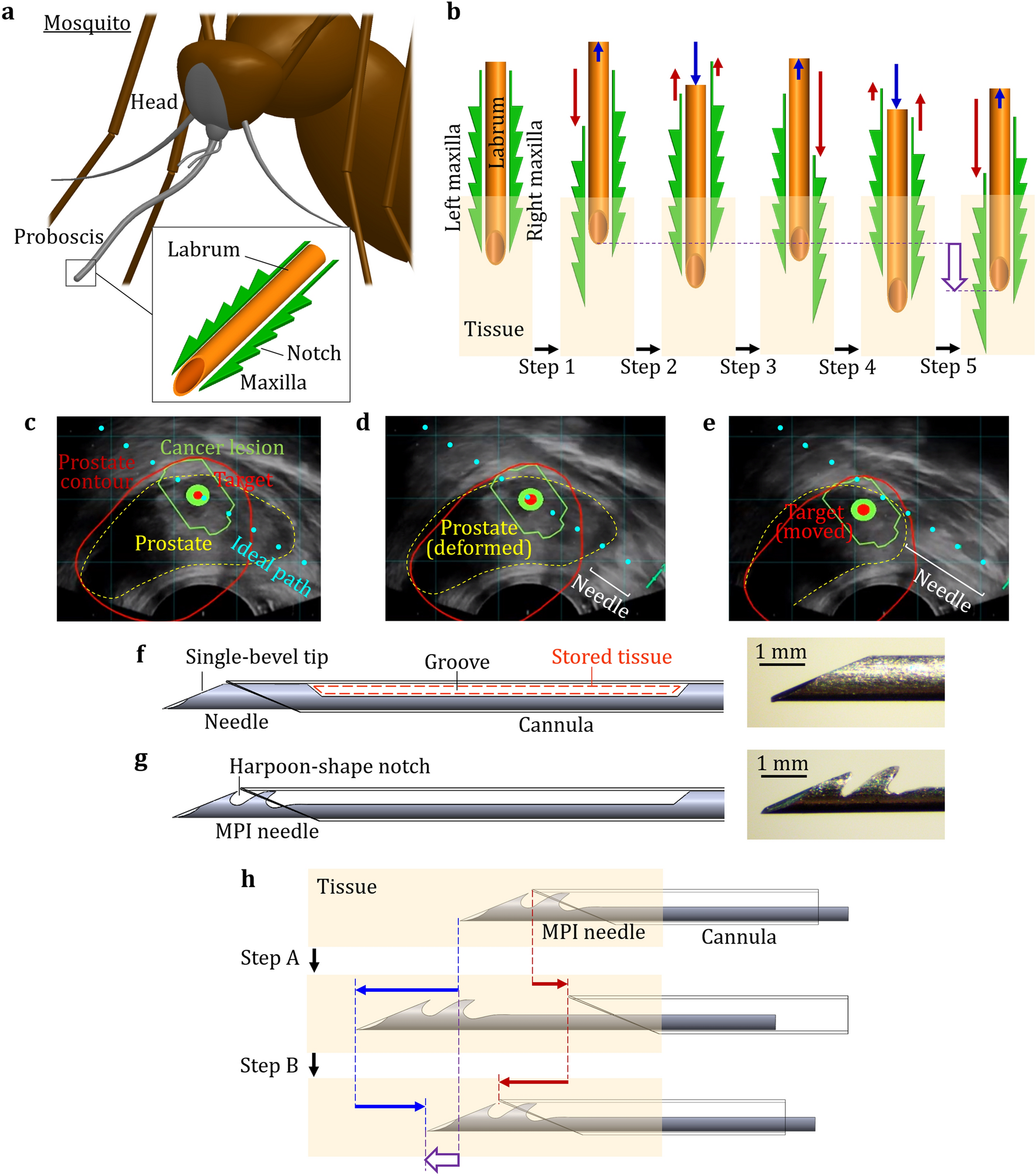
The study translates alternating movement into a biopsy needle and cannula. The medical images illustrate why displacement matters when approaching a target. Original Fig. 1 ↗, reproduced unchanged under CC BY 4.0.
Alternating motion depends on an assembly of moving parts. A conventional one-piece mould does not reproduce that assembly. Removing the motion while retaining the notch changes the mechanism being compared.
The wasp-inspired device developed by Bloemberg and colleagues (2024) makes this dependency visible. Six steel segments advance in sequence, with one moving forward while the others retract. A manual mechanism coordinates them; guides support the slender segments before entry. Its assembled diameter was approximately one millimetre. This was an instrument for advancement through a substrate, tested in gelatin, rather than a dissolving array carrying vaccine.
The mechanism includes everything behind the tip.
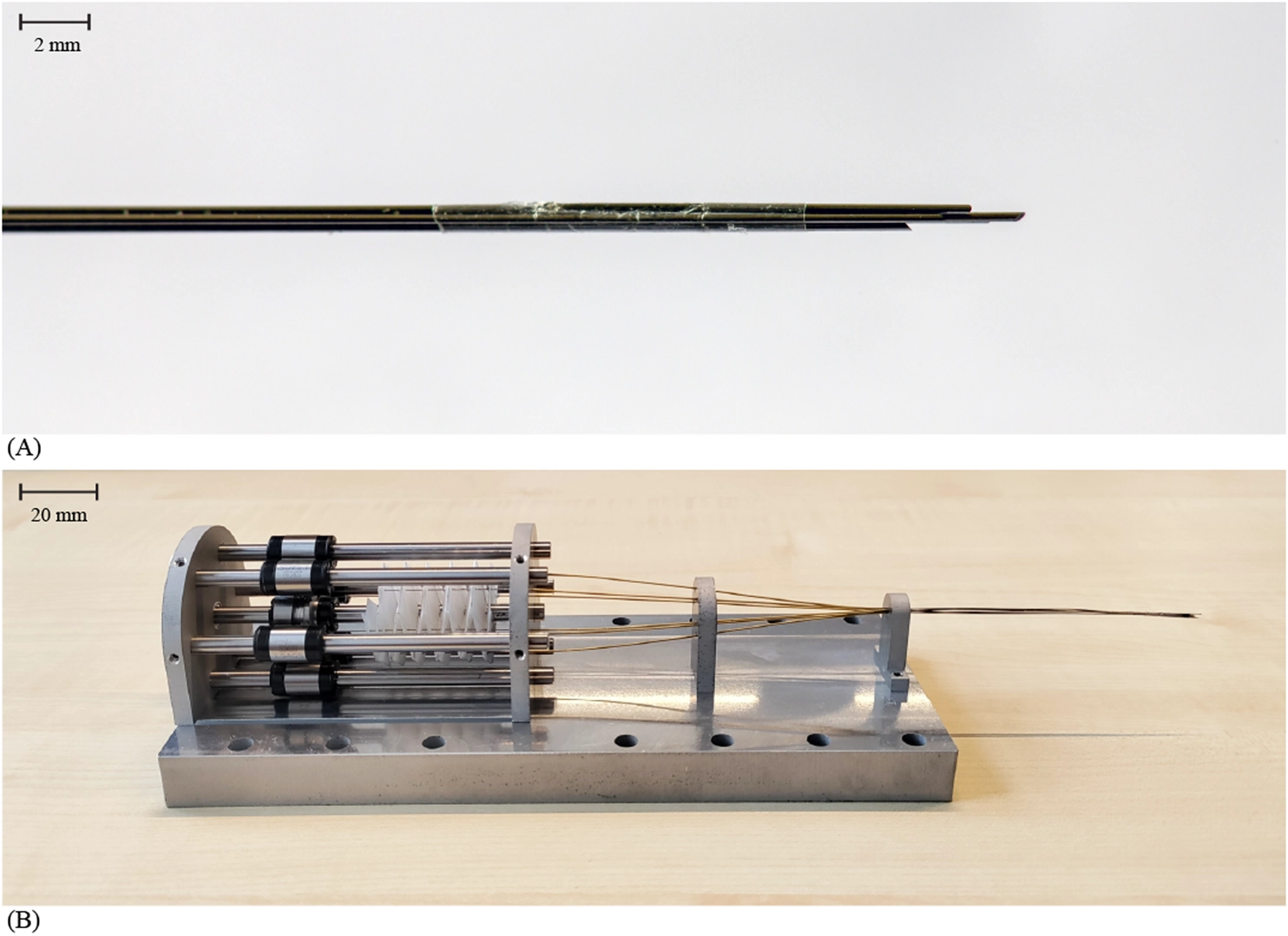
The instrument shows why support matters alongside tip shape. The unsupported length, the guides and the drive are part of the reported device; the needle tip alone does not explain its performance.
Barbs: entry and retention need separate tests
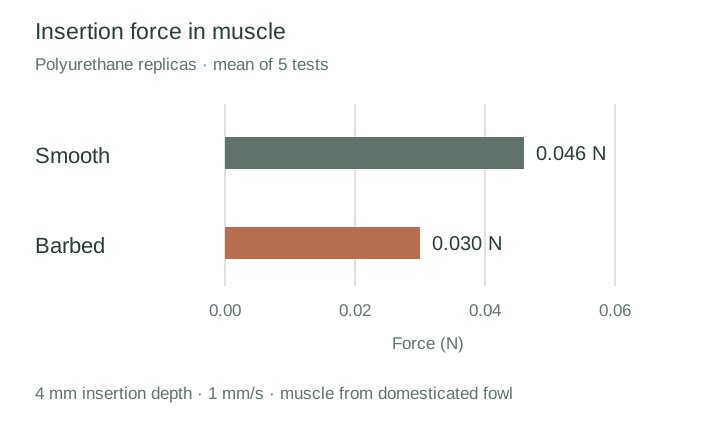
In Cho and colleagues’ porcupine-quill experiments (2012), barbed polyurethane replicas required less force to enter muscle than smooth replicas: 0.030 N versus 0.046 N at the tested depth, with five samples contributing to each mean. Surface features could concentrate deformation locally. The work also examined resistance to withdrawal. Lower entry force and stronger retention were distinct outcomes of the geometry.
Less force to enter. A separate question on removal.
A dissolving array adds several conditions. A small barb must fill in the mould, survive removal from it and remain intact until application. It must still perform after formulation changes alter stiffness and after storage changes moisture content. Once wet, it may soften or dissolve before it provides useful retention. If it persists, its effect on removal and local injury matters.
For a dissolving array, surface features introduce a trade-off between mechanical behaviour, mould filling and release. The quill study establishes an effect in its tested material and tissue. It does not establish the same effect after the feature is transferred to a dissolving formulation.
Swelling: a material can change its function after entry
Yang and colleagues (2013) used a different strategy, inspired by a parasite’s anchoring structure. Their microneedles combined a water-responsive outer material with a non-swelling polystyrene core. The tips expanded after entry and increased attachment to pig skin. The device was designed as a tissue adhesive. It offers a clear example of timing material behaviour, but its supporting core is not a dissolving vaccine matrix.
The tip swells after it enters tissue.
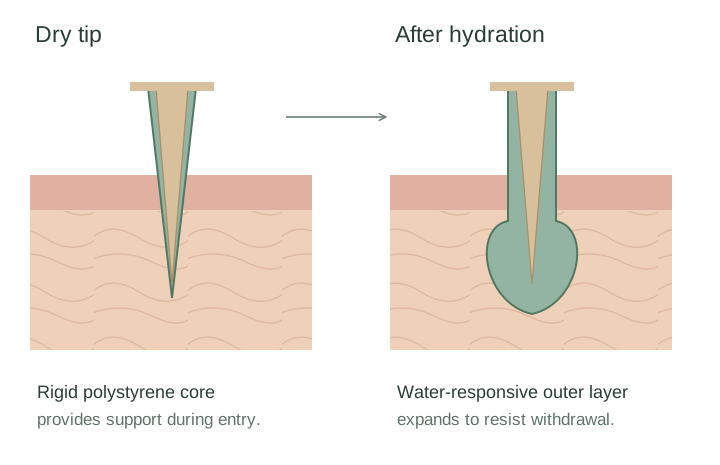
The study illustrates a change in function after entry: the structure first supports insertion, then hydrates and expands. A dissolving patch has a different intended endpoint. Swelling, dissolution and release cannot be treated as interchangeable processes.
The useful duration of attachment depends on the device’s purpose. Securing a graft and delivering a vaccine over a brief wear period impose different requirements.
Grooves: liquid delivery is a different architecture
Bae and colleagues’ snake-fang-inspired patch (2019) uses open grooves to convey a liquid formulation through capillary action. The accessible primary abstract supports that operating principle; we did not obtain the full methods for a detailed numerical comparison. It belongs in this analysis because it exposes a boundary: a fluid path is useful only while there is fluid to transport and a surface that supports the required flow.
A groove moulded into a solid dissolving needle does not inherit liquid-delivery performance. It changes the available structural cross-section and may affect wetting and dissolution, but those are new hypotheses. Retaining a liquid formulation could be a worthwhile alternative product architecture. It also brings a reservoir, containment and stability problem that a dry patch is intended to address. That choice should be explicit before borrowing the shape.