Abstract
We tested whether the amino-acid order in Epitalon (AEDG) has a consistent predicted advantage over every other sequence containing the same four residues. The complete comparison comprised 24 sequences, four histone/DNA contexts and three search seeds: 288 docking calculations.
AEDG ranked first in the human H1.0 context, twenty-third in human H1.4, tenth in chicken H5 and twentieth in H1.4 after DNA deletion. The strongest result is this dependence on structural context and the comparator distribution. The study did not directly demonstrate DNA binding, identify a gene-regulatory mechanism or measure telomerase activity.
Introduction
A chromatin-based explanation has been proposed for AEDG activity. Earlier work combined human-cell experiments with docking to modelled wheat histones. The species and structures in those parts of the argument differ, and a favourable score for AEDG alone does not establish that its residue order is exceptional.
Four distinct amino acids give a finite comparison set: 4! = 24 permutations. Holding composition and nominal charge constant controls obvious size and composition differences, while sequence order still changes terminal identities, geometry and conformational preferences. The other sequences are comparators; they are not assumed to be biologically inactive.
Our question was narrower than reproducing the earlier mechanism claim: does AEDG remain near the top of this complete sequence set under equal docking effort in several resolved chromatin environments?
Methods
Design and amendments
A dated protocol specified sequences, receptor contexts, search seeds and the ranking endpoint. Production effort was amended from exhaustiveness 8 and at most 15 poses to exhaustiveness 4 and at most 12 poses after measured throughput was slower than expected. Six control searches completed under the original settings were retained as superseded outputs and excluded from the primary comparison. Their scores were visible before the amendment; no AEDG score had yet been obtained. This was an exploratory study, not a blinded or prospectively registered confirmation.
Peptide representation
All 24 sequences were modelled as free-terminal, all-L tetrapeptides at pH 7.4, with a protonated amino terminus and deprotonated terminal, Asp and Glu carboxyl groups. The modelled net formal charge was −2. No terminal caps were introduced.
RDKit ETKDGv3 generated five candidate conformers per sequence. MMFF94 optimisation was attempted, and the lowest stored energy selected the docking conformer. Original convergence flags were not retained, so stored energies do not establish optimisation convergence. Meeko conversion preserved the selected conformer, with 27 heavy atoms and 13 torsional degrees of freedom per ligand.
Four structural contexts
| Context | Structure | DNA treatment |
|---|---|---|
| Human H1.0 | 7K5X · 2.93 Å cryo-EM | Retained |
| Human H1.4 | 7K5Y · 2.76 Å cryo-EM | Retained |
| Chicken H5 | 4QLC · 3.50 Å X-ray | Retained |
| Human H1.4, DNA deleted | Same 7K5Y protein coordinates | Removed; no equilibration |
The ordered linker-histone domain defined the centre of a 36 Å cubic search box. Missing histone tails were not constructed as rigid binding sites. Antibody fragments were removed from the human structures. The H5 structure contains a Drosophila nucleosome core, adding another contextual difference to the comparison.
Docking and endpoints
AutoDock Vina 1.2.7 used the Vina scoring function, a rigid receptor, flexible peptide and seeds 11, 22 and 33. Each sequence/context result was the median of its three best search scores. Lower scores ranked more favourably. AEDG was compared with the median of the 23 control-sequence medians within each context.
The scoring function contains shape-related, hydrogen-bonding, hydrophobic and conformational-penalty terms, without explicit electrostatic or solvation terms. Converted receptor partial-charge totals were zero; these files do not represent a physically charged chromatin model. Since the chosen score ignores those charges, correcting the file alone would not turn this into an electrostatic binding calculation.
Search seeds describe variation in the numerical search, not biological replication. No rank-derived significance test, pooled cross-receptor affinity or target-specific binder calibration was used.
Results
A complete screen with a context-dependent rank
All 288 expected sequence–receptor–seed combinations completed. Input identity, sequence order, terminal groups, formal charge and stereochemistry were checked against archived structures. All first-pose scores agreed with their corresponding result records. These checks establish computational consistency, not biological validity.
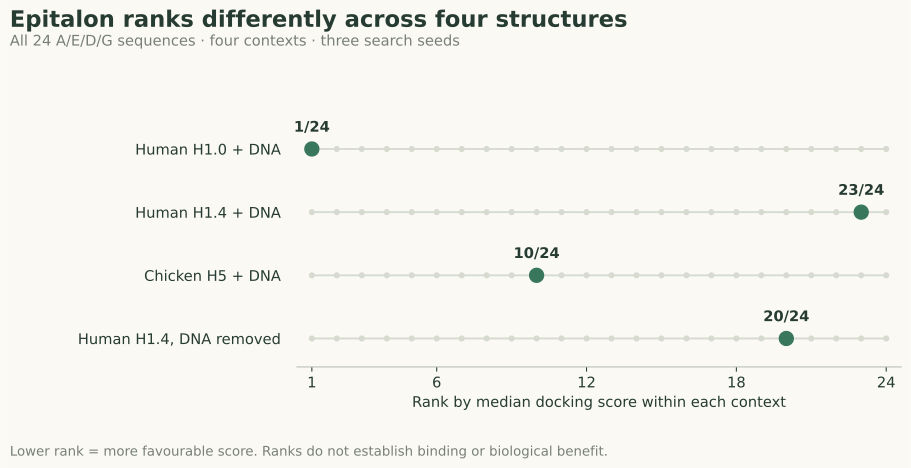
| Context | AEDG median | Control median | Rank / 24 | Seed ranks |
|---|---|---|---|---|
| H1.0 + DNA | −6.901 | −6.455 | 1 | 3, 4, 1 |
| H1.4 + DNA | −6.723 | −7.693 | 23 | 23, 20, 22 |
| H5 + DNA | −6.955 | −6.885 | 10 | 11, 10, 14 |
| H1.4, DNA deleted | −4.573 | −4.796 | 20 | 12, 20, 19 |
Scores use Vina’s kcal/mol convention; they are not measured binding free energies. AEDG’s own H1.0 and H1.4 medians differ by only 0.178 score units, while the corresponding control medians differ much more. Its rank reversal therefore reflects its position relative to each context’s full sequence distribution. It cannot be read as a measured H1.0-versus-H1.4 affinity difference.
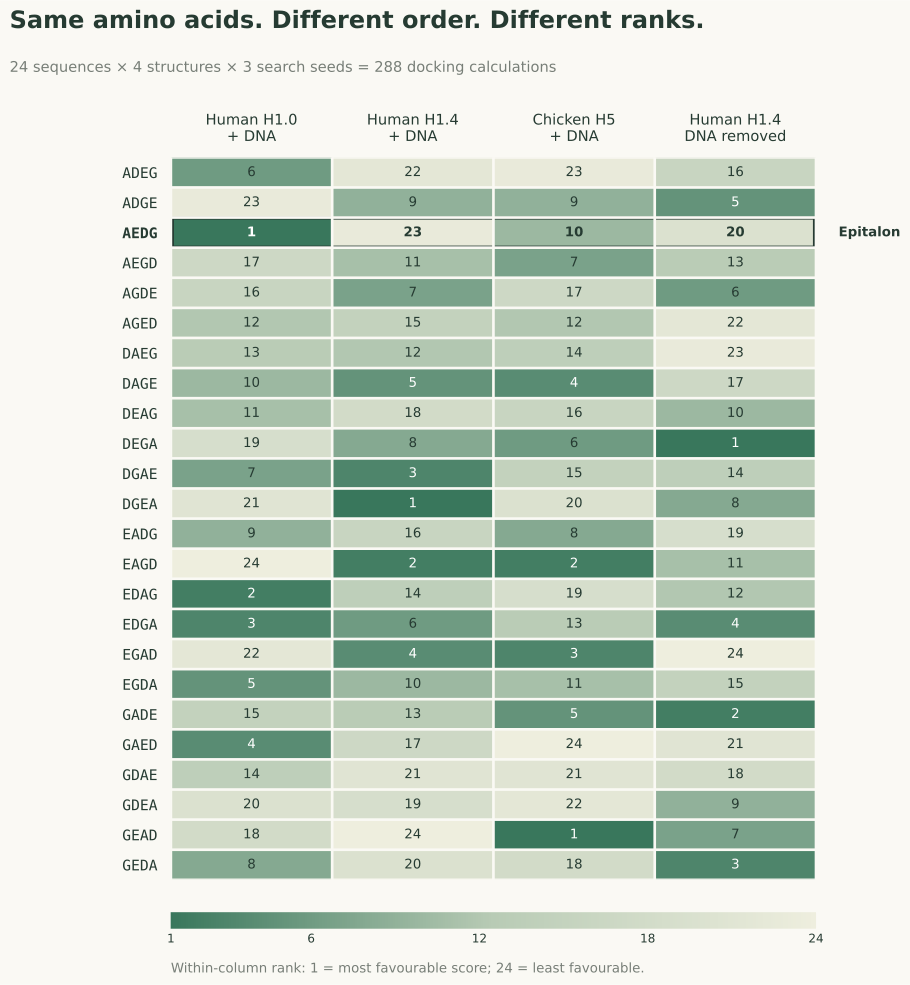
Search variation and pose location
AEDG remained near the top of H1.0 and near the bottom of H1.4 across the three seeds. Other rankings were less stable: seed-pair correlations across the full library ranged from 0.300–0.535 in H1.0, 0.627–0.786 in H1.4, −0.143–0.333 in H5 and −0.077–0.536 after H1.4 DNA deletion. Three seeds do not demonstrate search convergence.
All nine first-ranked AEDG poses in DNA-present contexts had heavy-atom contacts within 4 Å of both linker histone and DNA. No nucleosome-core contacts met that cutoff. The favourable H1.0 result thus occurs at a modelled histone–DNA interface, rather than an isolated histone pocket. Geometric proximity counts do not measure hydrogen bonds, binding strength or the energetic contribution of DNA.
What was not completed
Peptide-only integration benchmarks were used to investigate molecular-dynamics setup and speed. Production peptide–chromatosome trajectories and no-peptide controls were not run; the optional driver encountered topology problems. No molecular-dynamics result supports the docking interpretation.
No verified Epitalon perturbation-expression dataset was analysed. No DNA-binding assay, gene-regulation measurement, telomerase assay, telomere-length measurement or lifespan endpoint was performed.
Discussion
The finite permutation library makes a previously undercontrolled question testable. One favourable AEDG score would have suggested a broad preference. The complete comparison instead leaves a specific H1.0-context lead and a strong counterexample in H1.4.
The conditions differ in geometry, DNA arrangement, species composition and structure-determination method, as well as linker-histone identity. This design cannot isolate an isoform effect. Removing DNA changes both potential contacts and steric access while retaining an unequilibrated protein structure; it does not simulate DNA displacement or an experimentally resolved DNA-free state.
The docking comparison does not establish binding in solution or a downstream gene-expression response. Those remain separate biological questions.
Limitations
Rigid receptors, one selected starting conformer per sequence, limited search effort, missing optimisation flags and omitted solvent, ions and electrostatics constrain the result. No known binder/nonbinder benchmark calibrated this peptide–chromatin system. A contact audit checks where a stored pose lies; it does not establish that the pose occurs in solution.
The original wheat-histone contact list was recoverable as five numbered, noncontiguous residues. Treating their one-letter labels as a contiguous motif would be an invalid reproduction test. This human-context screen is a separate sensitivity analysis, not a replication of the earlier scoring method or cellular experiments.
Conclusion
AEDG’s predicted advantage is conditional on the tested chromatin context. H1.0 provides a hypothesis for controlled follow-up, while the H1.4 result argues against a general sequence advantage. The current calculations establish neither DNA binding nor gene regulation.
Research reading edition · 12 October 2026. AI assisted source work, analysis and preparation. The studies have not undergone external peer review.