Abstract
GHK is often discussed in relation to tissue repair and ageing. We asked whether existing expression data support two more specific propositions: a repair-associated response without a parallel profibrotic shift, and opposition to an independently validated age-associated expression pattern. The treatment experiment used GHK acetate in HFL-1 human lung fibroblasts, not a defined GHK–Cu preparation.
Neither proposition was confirmed. Repair-module shifts were small and the fibrosis direction changed with concentration. A fibroblast age score showed an unadjusted association in held-out donors, but failed the specified adjusted validation test. Low-dose opposition to that score therefore cannot establish rejuvenation. This study identifies the limits of the available experiment.
Introduction
Repair, fibrosis and ageing are related questions, but they require different evidence. Increased matrix production can contribute to wound closure or pathological scarring. A change in genes associated with age may reflect proliferation, stress or the composition of the sampled cells. Neither observation alone demonstrates restoration of tissue function.
We separated the analysis into two hypotheses. H1 asked whether the treatment moved a wound-related module without reinforcing an independently derived fibrosis programme. H2 asked whether it opposed an age-associated score that first demonstrated generalisation to held-out adult donors. The age-score validation was a prerequisite for interpreting a treatment shift, rather than a check to be waived after a favourable result.
Methods
Treatment identity and experimental unit
The deposited GSE27597 experiment contains vehicle, 100 pM GHK, 10 nM GHK and TGF-β conditions after 48 hours. The source identifies the compound as GHK acetate. The lower concentration is 0.1 nM; it should not be read as 100 nM. A preformed copper complex and copper-only control were absent.
Eight processed arrays were available: two per condition from one HFL-1 cell line. The paper describes three passage-derived replicates, which does not reconcile with the two deposited arrays per condition. These arrays are not independent human donors. The primary methods give TGF-β as 10 ng/mL, whereas the GEO metadata give 10 ng/µL; that source discrepancy remains unresolved.
Array identity and feature matching were checked before the comparisons. The treatment matrix contained 19,793 features, mapped to 19,217 unique genes. Within-condition correlations were high, approximately 0.994–0.996, but a high global correlation does not establish a precise estimate of a small treatment effect. Raw-array quality control and donor-level treatment replication were unavailable.
Repair and fibrosis modules
The fibrosis reference came from disease-versus-control fibroblast and myofibroblast expression in GSE135893. It contained 139 disease-up and 144 disease-down genes. The wound annotation contained 455 genes, of which 440 were measured; removing 17 genes overlapping the fibrosis set left a disjoint 423-gene wound module. This broad, unsigned annotation is a measure of expression, not a functional wound-healing assay.
Modules and the analysis protocol were locked locally before treatment contrasts. This was a dated analysis decision, not a public preregistration. A secondary comparison examined similarity to the TGF-β contrast and the wound signal remaining after that comparison. Shared controls and expression noise limit causal interpretation of this residualisation.
Age-reference validation
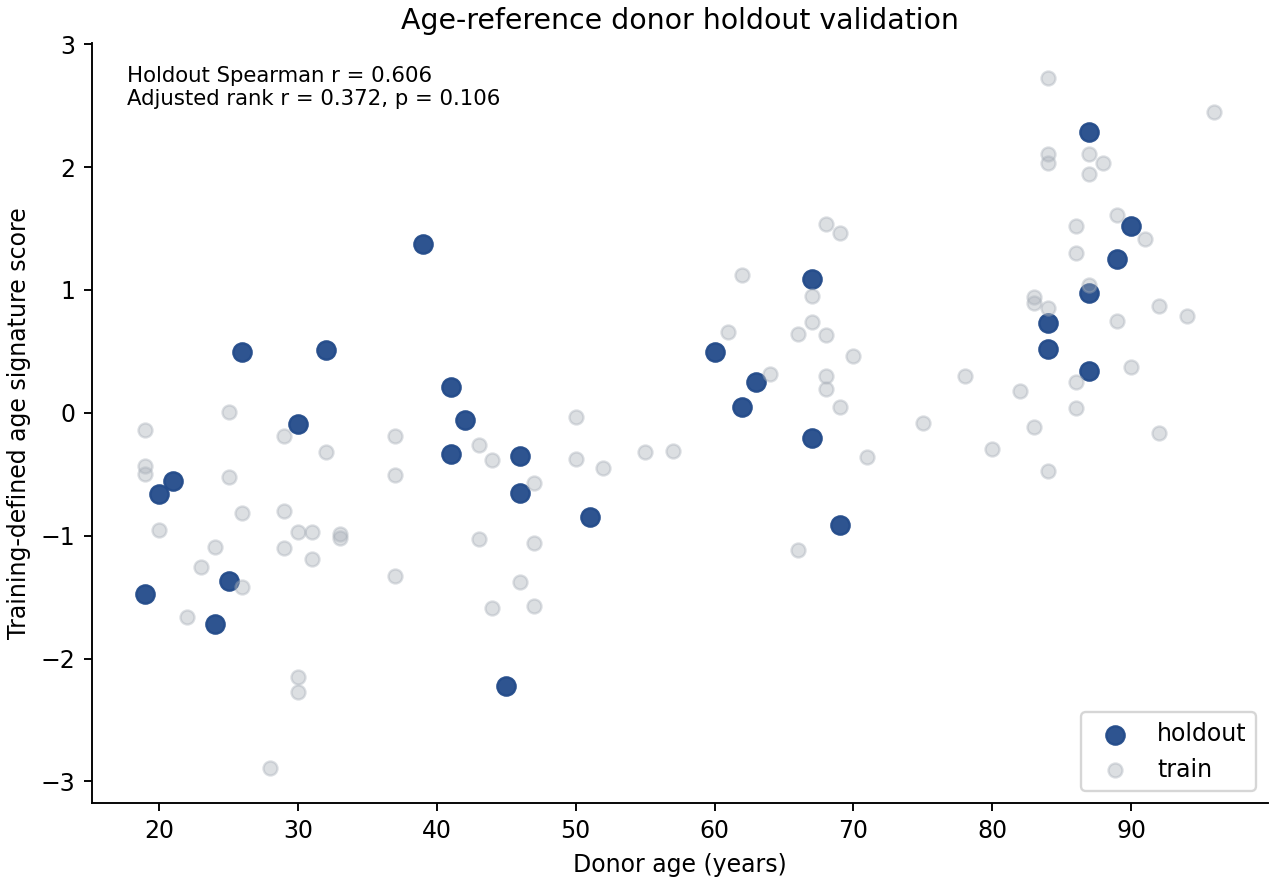
GSE113957 contains 143 fibroblast profiles, including ten progeria samples. The adult normal-donor analysis used 111 donors aged 19–96: 82 male and 29 female. A fixed split assigned 82 donors to training and 29 to a holdout within the represented batches.
Age, sex and batch were included in the training model. Standardisation and gene selection used training data only. Four hundred genes—200 increasing and 200 decreasing with age—were selected from 10,368 eligible genes. The held-out association had to remain positive and meet p < 0.05 after adjustment. Age–batch confounding, missing passage information and transfer from dermal RNA sequencing to lung-cell microarrays remained limitations.
Results
Repair and fibrosis did not separate as proposed
The low concentration reduced the fibrosis score slightly but did not increase the wound score. At 10 nM, both shifts were small and positive. Neither condition gave the proposed pattern of a clear repair-associated shift without fibrosis.
| Contrast | Fibrosis score | Disjoint wound score |
|---|---|---|
| 0.1 nM GHK − vehicle | −0.0576 | −0.0114 |
| 10 nM GHK − vehicle | +0.0122 | +0.0085 |
These are changes on the analysis-specific module scales, not percentages of healing or fibrosis. With two treated and two control arrays, there are only six treatment-label allocations; the smallest two-sided exact permutation p-value is one third. Treating thousands of genes as independent treatment replicates would not solve that constraint.
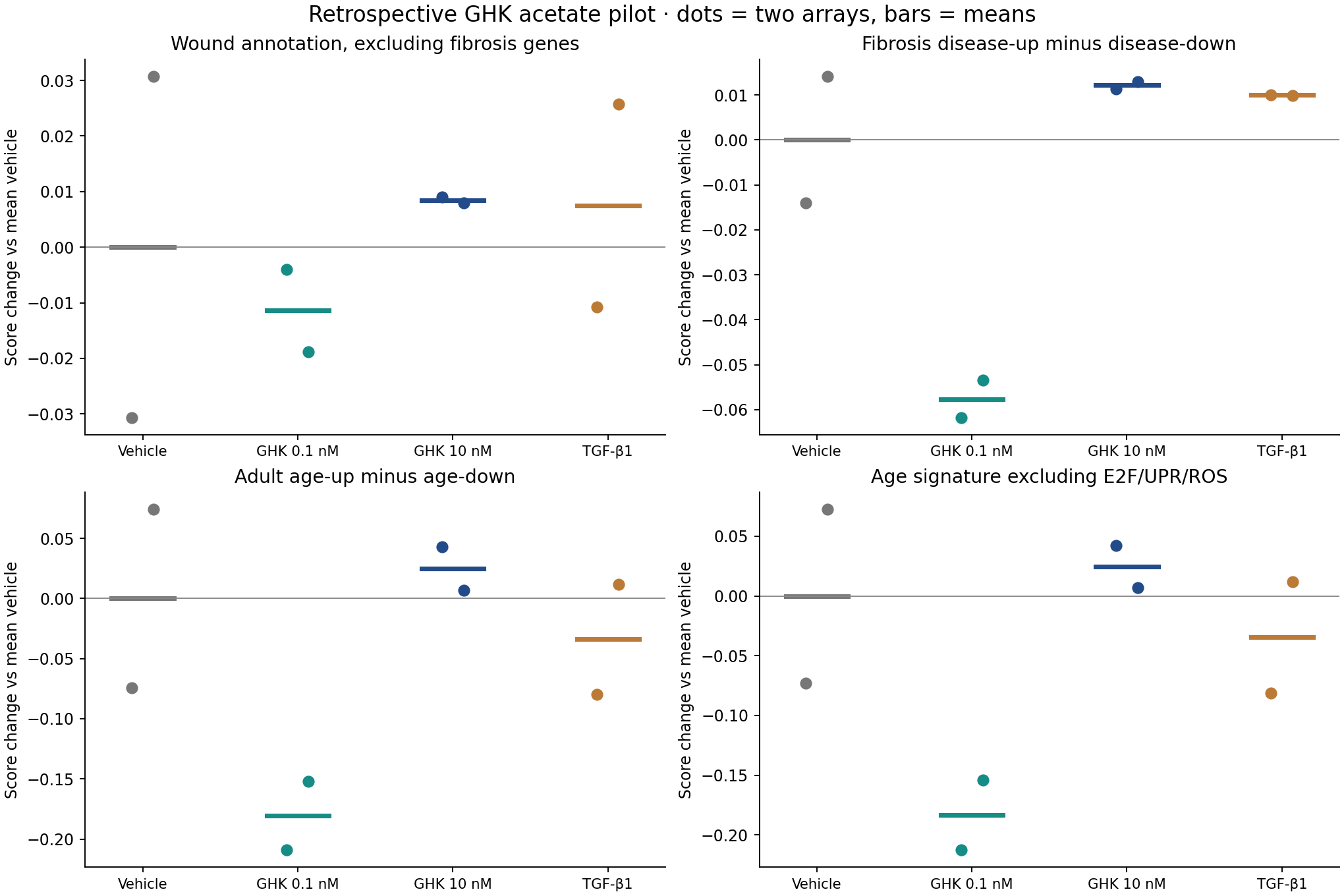
The GHK contrasts correlated with the TGF-β contrast at r = 0.506 and 0.447, corresponding to 25.6% and 19.9% shared variation in these comparisons. The residual wound shifts were −0.0066 and +0.0045. This does not isolate a TGF-β-independent mechanism: the contrasts share a control, and statistical subtraction is not a pathway intervention.
The age score failed its adjusted holdout criterion
The unadjusted held-out Spearman association was 0.606, p = 0.00049. After adjustment, it was 0.372, p = 0.106. The latter did not pass the preselected validation criterion. Showing only the unadjusted scatter would give an incomplete account of the validation.
On that unvalidated reference scale, low-dose GHK shifted the score by −0.1806 and high-dose GHK by +0.0247. Removing stress-related genes left similar directions, −0.1835 and +0.0246. However, low-dose E2F and unfolded-protein-response scores also increased, by +0.1379 and +0.0898. These observations do not establish a stress-independent rejuvenation response. A response-matched comparison with unrelated perturbations was not completed.
Discussion
The useful result is a distinction between a promising biological question and what this dataset can decide. The analysis does not show that GHK lacks repair activity. It shows that these expression contrasts do not confirm the two specified hypotheses. Small module shifts in one cell line cannot substitute for a measured change in healing, scarring or tissue function.
The experiment used GHK acetate and did not include a preformed copper complex or copper-only control. Its expression results cannot establish a copper-specific effect.
The age-reference validation did not pass the specified adjusted holdout criterion. A shift on that scale cannot establish age reversal.
Limitations
This is a retrospective feasibility analysis of processed public data. The small treatment experiment, unresolved replicate and metadata discrepancies, single cell line and cross-platform transfer restrict inference. The fibrosis and wound modules simplify heterogeneous programmes; neither is an experimentally validated surrogate for the desired tissue outcome. The held-out age test did not pass, and the missing perturbation controls limit specificity.
No new tissue experiment, copper-binding experiment, clinical study or biological-age intervention was performed. Independent recalculation checked the numerical module and age-score outputs; it could not repair the source experiment or validate the biological interpretation.
Conclusion
The available data do not confirm repair without fibrosis or a validated age-opposing effect. The source experiment and the unvalidated age reference limit what can be concluded.
Research reading edition · 12 October 2026. AI assisted source work, analysis and preparation. The studies have not undergone external peer review.