Abstract
This audit revisited the original tables and figures behind Pinealon (EDR) performance claims in humans, rats, macaques and mice. We recomputed 20 human-table percentage comparisons, checked rat endurance summaries and recovered the original macaque task counts and selected mouse figure means.
The human paper’s printed 24% work-capacity improvement does not match its displayed means, which give 34%. The rat study contains a positive endurance signal, but the treated gain exceeds the trained-control gain by eight minutes rather than the full eighteen-minute within-group improvement. Macaque learning is confounded with practice and order; the mouse source reports no statistically significant Pinealon advantage on the examined outcomes. These findings refine the hypotheses without establishing human performance efficacy.
Introduction
Before interpreting a performance claim mechanistically, its source numbers and comparisons need to be recoverable. A before–after improvement may include training, familiarisation and recovery. A percentage can change because its denominator differs. A cell or blood marker may be biologically interesting without measuring sporting performance.
We therefore separated three questions: what the source reports, what can be recalculated from the displayed data, and what the design permits us to attribute to treatment. The species, preparations and endpoints were kept separate throughout.
Methods
This was a targeted retrospective audit, not an exhaustive systematic review or prospectively registered study. Discovery leads were traced to original Russian papers and a public mouse preprint. Four original PDFs were recovered. A separate 2018 male-wrestler chapter behind claims of 45% greater physical work and 15–22% greater mental work was not located.
For human tables, percentage change was calculated as 100 × (after − before) / before. Twenty distinct printed comparisons were checked; an alternate unit for the same work-capacity endpoint was used as an arithmetic cross-check rather than counted twice. Missing observations were not replaced with zeros or reconstructed individuals.
Rat summaries were compared both as minutes gained and as percentages of baseline. The trained untreated group remained the relevant control. The macaque analysis retained the distinction between four task comparisons and two independent animals. Mouse means were read approximately from selected source figures; animal-level values, pairing and standard errors were not recovered.
Two attempts to digitise the rat’s full time course failed source-anchor checks. Those extracted curve values were excluded. The numerical audit concerns displayed aggregate data and cannot reproduce an individual-level treatment analysis.
Human performance
The work-capacity discrepancy
Lysenko and colleagues studied 18 female judokas aged 16–22 before and after a 15-day oral course; ten supplied the blood measurements. There was no concurrent untreated or placebo group. The formulation and regimen must not be assumed equivalent to a contemporary injectable EDR preparation.
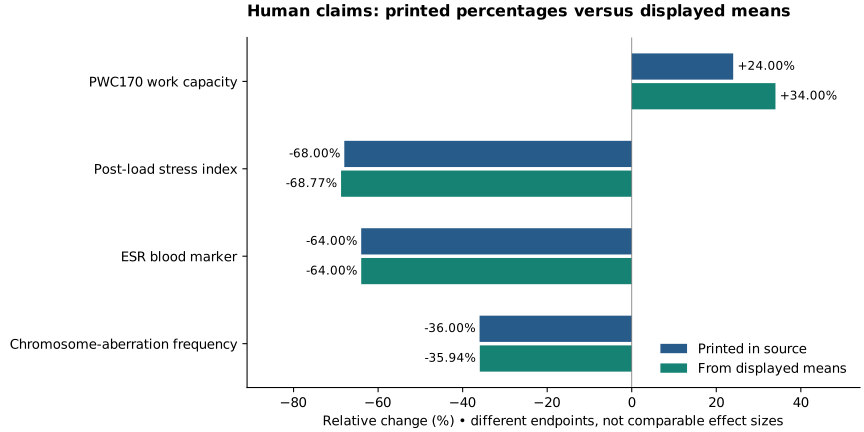
PWC170 increased from 138.26 to 185.27 W: +47.01 W, or +34.00%. The paper prints +24%; its alternate kg·m/min values also yield approximately +34%. This identifies an internal inconsistency without establishing whether a mean, percentage or another field is wrong. It is not evidence of a larger drug effect than originally reported. PWC170 is a cycle-ergometer work-capacity test at a specified heart rate, not competitive performance or directly measured maximal oxygen consumption.
Other endpoints and statistical reporting
The post-load stress index decreased by 68.77%, close to the printed 68%. ESR decreased by 64.00%, and chromosome-aberration frequency by 35.94% relative, equivalent to 2.34 percentage points. Static balance increased from 12.86 to 25.45 seconds. These calculations do not demonstrate DNA repair, reduced subjective stress, rejuvenation or sporting benefit.
The paper states that it used Student’s t test, but does not define the error term in “M ± m” or specify pairing. Four post hoc selected discrepancies were checked under both SEM and SD interpretations. Under the tested paired and independent t-test assumptions, the displayed values did not reconcile with the printed p-value categories. These conditional checks are not corrected study p-values: original records and an unambiguous analysis description are required.
The absence of a concurrent control remains decisive even if every arithmetic discrepancy were resolved. Training, repeated testing and other time-related changes are alternative explanations.
Rat endurance
Belyaeva and colleagues used 24 male rats in four groups of six: untrained controls, trained untreated controls, trained rats receiving metaprot, and trained rats receiving Pinealon. Running-to-exhaustion was measured repeatedly.
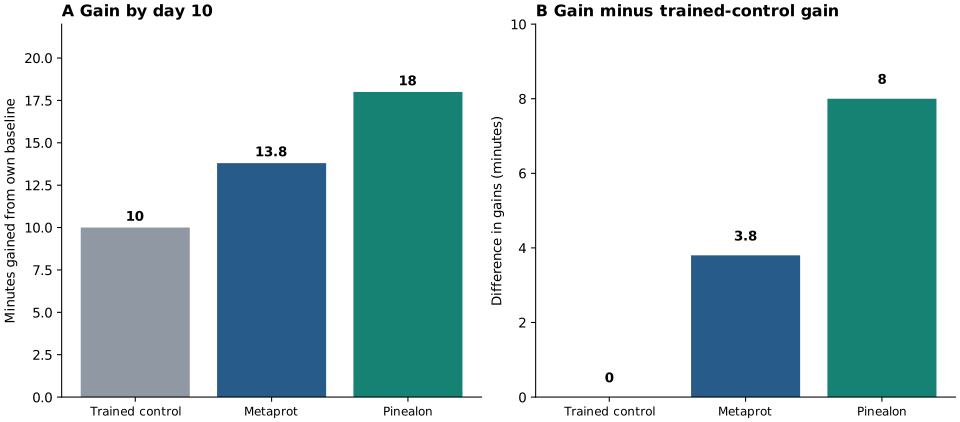
The Pinealon group’s eighteen-minute gain contains the improvement also seen with training alone. The eight-minute difference in gains is the more informative descriptive comparison, but it remains affected by baseline imbalance and incomplete allocation information. It is not a baseline-adjusted causal estimate.
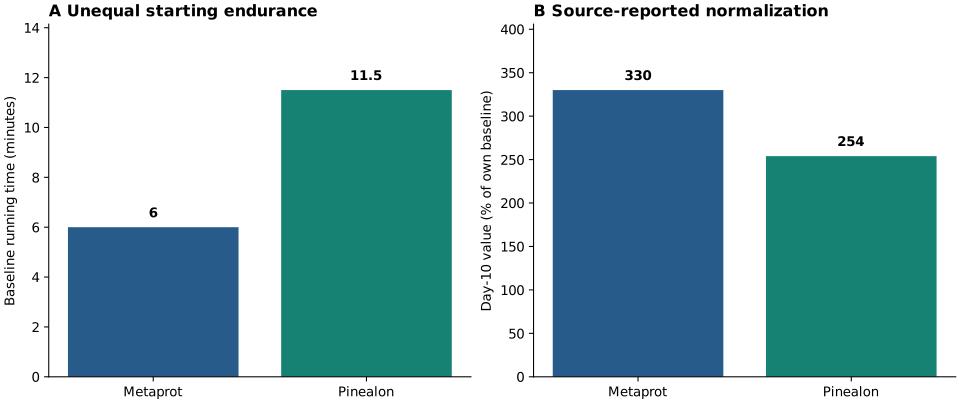
The paper’s “254% of baseline” means a 154% increase. Adding the rounded eighteen-minute gain to Pinealon’s 11.5-minute baseline gives 29.5 minutes, or 256.52% of baseline; the small discrepancy is retained. The control baseline can only be reconstructed approximately from rounded summaries. A reported 65-minute run was an individual maximum, not the group mean. Three days of post-treatment observations cannot establish a general absence of withdrawal.
Cognition and mouse findings
Two macaques, four task comparisons
Kuznetsova and colleagues tested two rhesus macaques before and after a ten-day oral course. Later tasks required fewer stimulus presentations. The reductions ranged from 11.11% to 62.50% across the four animal/task comparisons.
| Animal / task | Before | After | Reduction |
|---|---|---|---|
| Krokha · colour | 300 | 210 | 30.00% |
| Krokha · form | 330 | 270 | 18.18% |
| Nyuren · colour | 270 | 240 | 11.11% |
| Nyuren · form | 480 | 180 | 62.50% |
Practice, fixed order and changed stimuli remain entangled with treatment. Repeated trials do not increase the number of independent animals. The paper labels an R² quantity as a correlation coefficient; we did not silently relabel it as r.
The mouse experiment
The 2026 mouse preprint reports randomised treatment groups, generally with five animals each, followed for eight weeks. It reports no statistically significant Pinealon advantage in grip strength, locomotion or the examined Y-maze outcomes. A working-memory trend remains a possible lead, not an established effect; a small nonsignificant study also cannot prove equivalence.
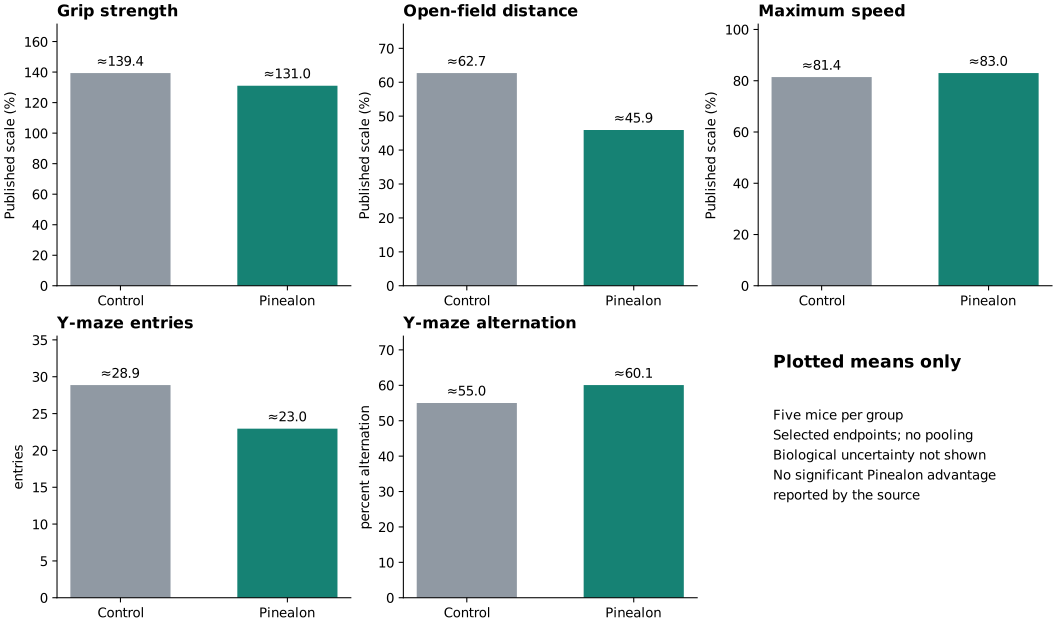
Ten approximate bar means were recovered for five selected endpoints. Alternation was approximately 55.0% in control and 60.1% with Pinealon, a descriptive gap of about five percentage points. Reading tolerances describe pixel location and axis calibration, not biological confidence intervals.
Y-maze testing occurred only at week eight. The source’s daily dose wording conflicts with its twice-weekly injection schedule, and matched control injections are not clearly reported. Cage-level intake and pooled urine are not independent mouse-level observations. The study did not measure lifespan or establish general safety.
Discussion
The strongest preclinical lead in this audit is adaptation to repeated exertion. The controlled rat experiment motivates a baseline-balanced replication with clearly specified training, allocation, exposure and recovery measurements. It does not yet establish a human ergogenic effect.
The human observations are worth resolving at source. The PWC170 inconsistency and conditional statistical discrepancies make the original records more valuable than further calculations on rounded means. The missing male-wrestler chapter must remain unresolved; the female cohort cannot be used to validate its claims.
A separate vendor-hosted manual describes a combination of Pinealon and Kristagen in gymnasts. That is a source lead concerning combination exposure, not a substitute for the missing single-product evidence. Different products, routes and species were not pooled into one efficacy estimate.
Limitations
Source selection was targeted and incomplete. Aggregate summaries omit covariance, individual changes and many design details. Figure reconstructions are approximate and the mouse endpoints were selected after viewing the source. Excluded digitisation failures constrain the rat time-course analysis. None of these gaps can be repaired by treating additional table rows as independent subjects.
This audit generated no new biological observations. It did not include DNA-binding simulations or gene-regulation testing. AI assisted retrieval, translation, extraction, calculations and drafting; automated audits do not constitute external peer review.
Conclusion
Several source calculations are reproducible, and the rat endurance result merits controlled follow-up. Human performance efficacy remains unresolved. The next useful advance is better experimental and source data, rather than a stronger mechanistic claim built on the same summaries.
Research reading edition · 12 October 2026. AI assisted source work, analysis and preparation. The studies have not undergone external peer review.