Question
Before testing whether a cell model predicts a response, its inputs must represent the measured data consistently. Gene identifiers in an expression dataset may not all appear in the model’s vocabulary. Excluding an unmatched gene can also change a normalisation denominator, depending on the input procedure.
We checked five selected untreated cell records from EmeraldBay against a cell model’s gene mapping. This was an input diagnostic. It did not run the model, fit a predictor or measure response-prediction accuracy.
Methods
The check counted observed gene entries, entries recognised by the mapping and entries outside that vocabulary. It also checked whether each cell was empty or all zero, whether observed totals were positive and finite, and whether any observed values were non-integer.
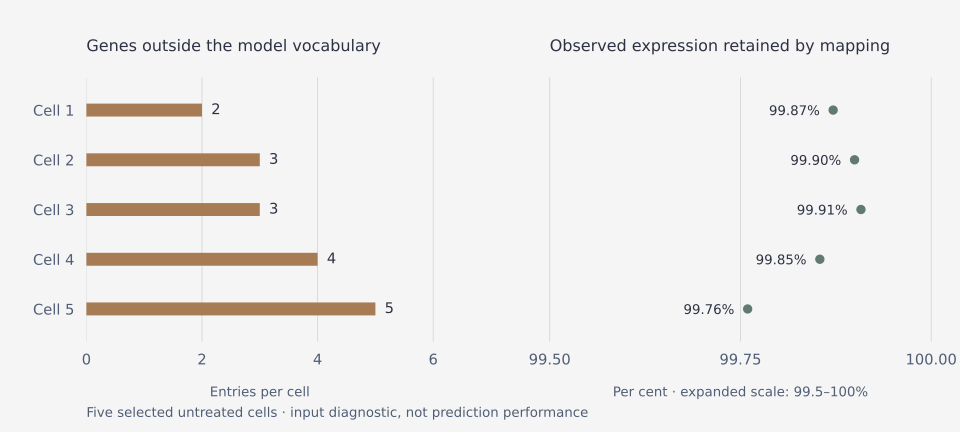
Mapped-expression coverage was calculated separately for each cell: the sum of observed values attached to recognised genes, divided by the sum of all observed values in that cell. This is a measure of retained expression values, not the fraction of genes recognised and not a model-accuracy score.
The strict compatibility rule required no unsupported gene entries. Reagent, research software developed with SovietRx, supported the execution records and input checks.
Results
All five cells were nonempty and had positive, finite observed totals. No non-integer observations were found. Those properties alone do not establish the measurement units or suitability for a particular model.
Each cell contained two to five gene entries outside the mapping. Across the five cells, 17 of 8,963 observed entries were unsupported. Mapped-expression coverage ranged from 99.76% to 99.91%. The strict compatibility check was therefore not met for any of the five cells.
| Record | Observed gene entries | Unsupported entries | Mapped expression | Strict check |
|---|---|---|---|---|
| Cell 1 | 993 | 2 | 99.87% | Not met |
| Cell 2 | 1,623 | 3 | 99.90% | Not met |
| Cell 3 | 2,177 | 3 | 99.91% | Not met |
| Cell 4 | 2,136 | 4 | 99.85% | Not met |
| Cell 5 | 2,034 | 5 | 99.76% | Not met |
The result identifies an unresolved input-handling question. It does not show that these cells are biologically invalid, or that a model could not use them after a justified transformation.
The unresolved input rule
The diagnostic does not establish whether the observed vocabulary mismatch changes a model’s predictions. That depends on its input transformation and normalisation procedure.
The transformation must therefore be specified and checked against the intended procedure before interpreting model outputs. A high coverage percentage is not a reason to silently relax the compatibility rule. Any revised rule needs its own justification and evaluation.
Scope and limitations
Five selected cells are a small diagnostic sample, not a representative assessment of the full dataset. The diagnostic concerns cancer-cell data; it establishes no result for vaccine responses, peptides or healthy tissue.
This record documents the input check completed on 12 October 2026. It reports input compatibility, not predictive performance.
Input diagnostic · Measurements recorded 12 October 2026. The figure reports the completed five-cell input check. No new model run was performed for this reading edition.