Question
A measurement taken after a challenge can hide different histories. One sample may have changed little; another may have changed substantially and already recovered. A third may still be returning towards its baseline.
This note defines three summaries of that time course: response depth, half-recovery time and the remaining change at the end of observation. The method was developed under the name Virtual Reserve Dynamics (VRD). These definitions describe a recovery curve; their interpretation depends on the measured biological system.
The current work establishes the definitions and the information an analysis would need. It does not report a validated recovery scorer or measured performance across biological systems.
Measurement
The starting definition concerns a named functional signal that falls during a reversible challenge. Baseline measurements, the timing of challenge removal and the final observation time must be recorded alongside the signal.
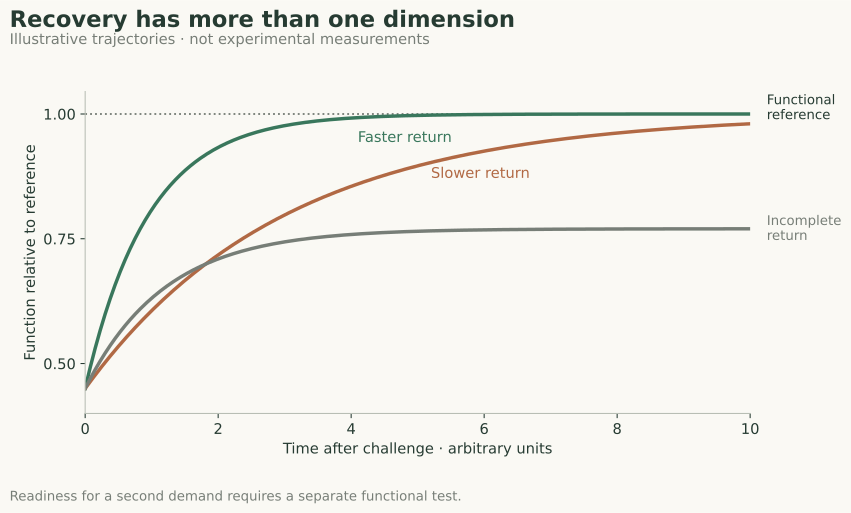
For a direct estimate, the half-recovery threshold would be located between neighbouring observations and the crossing time interpolated. The sampling interval matters: measurements several hours apart cannot resolve a return that happens in minutes. A threshold that is not reached during observation should be reported as not reached, rather than assigned a recovery time beyond the data.
Reading a recovery curve
A fitted exponential offers a different summary. Its half-time describes a return towards the fitted endpoint. If that endpoint lies below the original baseline, this is not automatically the time needed to regain half the original loss. The observed threshold crossing and the fitted estimate should remain distinguishable.
Baseline drift, measurement noise and multiple recovery phases can change all three quantities. Overshoot or a delayed second response may make a single monotonic recovery model inappropriate. The analysis must retain these features rather than smooth them into an apparently simple return.
Neither a low residual nor a short half-time is universally desirable. Interpretation depends on what the signal measures and why it changed. The definitions describe a trajectory; the experiment determines its biological meaning.
Data requirements
Each comparison needs a named measurement and unit, an experimental unit such as a donor or specimen, repeated baseline observations, challenge timing and sampling times. It also needs a fixed rule for the response reference, a minimum change distinguishable from noise, missing observations and the end of follow-up.
Repeatability matters when comparing treatments or donors. Repeated observations from one specimen are not independent specimens.
Published recovery measurements
The University of Málaga treadmill collection contains cardiorespiratory time courses. Recovery takes place under continued walking, which matters when interpreting a return towards baseline. Its associated comparison of recovery calculations illustrates why the definition of a measure matters.
Use in tissue experiments
A recovery curve describes change over time. Its interpretation depends on what the measured signal represents.
A tissue’s return towards its previous state and a vaccine’s durable immune response are different outcomes. A persistent signal alone cannot distinguish useful immune memory, continued exposure, injury or another process. That distinction requires the appropriate controls and biological measurements.
Method note · 13 October 2026. Illustrations explain the method; they are not experimental results.